
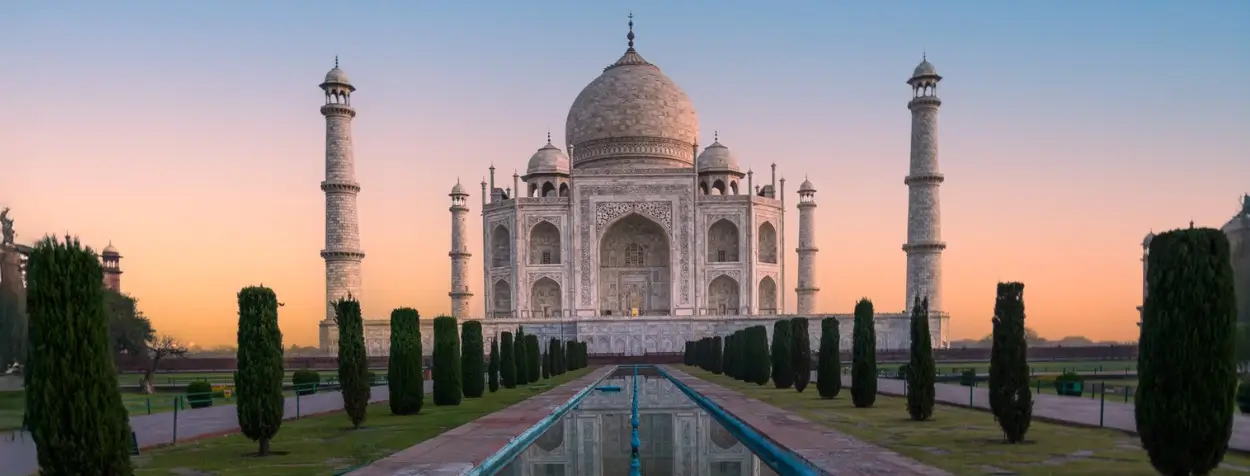
Two nights in Jaipur is the detail that sets this classic route apart, because it turns the Pink City from a rushed afternoon into a full day of forts, palaces and markets. The golden triangle tour 5 days itinerary from Payless Tours India is our most booked plan for people on their first visit to India. It covers the three cities in the order most travellers find easiest, Delhi first, then Agra, then Jaipur, and leaves enough slack in each day for a proper lunch, a rest at the hotel and an evening walk.
Delhi gets a full first day with a guide, taking in the twelfth-century Qutub Minar, the Mughal garden tomb of Humayun and the ceremonial avenues of New Delhi. In Agra you see Agra Fort in the afternoon light and the Taj Mahal at sunrise the following morning. Jaipur then has a whole day to itself, starting at Amber Fort and Nahargarh on the ridge and finishing in the bazaars of the old walled city, followed by a relaxed morning drive back to Delhi on the last day.
A private air-conditioned car and an English-speaking driver stay with you throughout, and licensed local guides join you in Delhi, Agra and Jaipur. You can choose 3-star, 4-star or 5-star hotels, and the dates are flexible. Many guests add a few days in Udaipur, Varanasi or Ranthambore after this golden triangle tour 5 days plan, and our team can arrange the extension.
Each day below has space for a destination photo. Days without an image simply show the description full-width — clean and consistent either way.
On arrival at Indira Gandhi International Airport, a representative of Payless Tours India meets you outside the arrivals hall and takes you to your hotel. If you land in the morning, the city tour starts after a short rest. Your guide begins at Qutub Minar in South Delhi, a five-storey tower of red and buff sandstone started in 1193 by Qutb-ud-din Aibak, the first Sultan of Delhi. Bands of Arabic inscriptions wrap around each storey. In the same courtyard stands the Quwwat-ul-Islam mosque, built partly from the columns of earlier Hindu and Jain temples, and a seven-metre iron pillar from the Gupta period that has resisted rust for about sixteen centuries.
From Mehrauli you drive to Humayun's Tomb in Nizamuddin, commissioned by the emperor's widow, Bega Begum, and completed in 1570. It was the first large garden tomb in India, set in a charbagh divided into four parts by water channels, and its double dome was copied in later Mughal buildings, including the Taj Mahal. A restoration led by the Aga Khan Trust brought the gardens and fountains back to working order. Your guide also takes you to Gurudwara Bangla Sahib near Connaught Place, where volunteers serve free vegetarian meals to thousands of people every day. You can sit on the floor and eat with everyone else, or look into the kitchen where huge pots of dal are stirred by hand.
Late in the afternoon you drive along Kartavya Path from India Gate, a 42-metre memorial arch built in 1931 for Indian soldiers of the First World War, up to Rashtrapati Bhavan and the North and South Block secretariat buildings on Raisina Hill. Your guide explains how Edwin Lutyens and Herbert Baker combined European classical columns with Indian chhatris and jali screens. If the light holds, a short stop at the National War Memorial is worthwhile. In the evening you can walk around the white Georgian colonnades of Connaught Place for dinner, or rest at the hotel after the flight. Overnight stay in Delhi.
After breakfast you check out and leave Delhi on the Yamuna Expressway. The drive to Agra takes around three and a half to four hours, mostly through wheat and mustard fields in Uttar Pradesh, with brick kilns and their tall chimneys dotting the flat land. Your driver will stop at one of the expressway food plazas for coffee and a restroom break. You reach Agra around lunchtime and check in at the hotel. Before sightseeing, your guide can recommend a place for lunch; Mughlai food is the local speciality, so dishes such as mutton korma, dal makhani and tandoori breads are good choices here.
In the afternoon your guide takes you to Agra Fort, a UNESCO World Heritage Site on a bend of the Yamuna about two and a half kilometres upstream from the Taj Mahal. Akbar rebuilt it in red sandstone from 1565, and three generations of emperors added to it. You walk through the Delhi Gate side and the Amar Singh Gate, into the Diwan-i-Am, the hall of public audience with its rows of scalloped arches, and on to the Diwan-i-Khas, where the Peacock Throne once stood. The Jahangiri Mahal shows Hindu-style brackets and carved balconies, a sign of Akbar's Rajput marriages. From the marble terraces of the Musamman Burj you get your first view of the Taj Mahal downriver.
As the afternoon light softens, you cross the Yamuna by car to Mehtab Bagh, the Moonlight Garden, laid out by Babur and later aligned with the Taj Mahal by Shah Jahan. Excavations here found an octagonal pool that once reflected the tomb. From the river edge you see the Taj Mahal from behind, without the crowds or the security lines of the main complex. Sunset is the best time, when the marble takes on shades of peach and lilac. Afterwards you return to the hotel. Dinner is at your own pace, and an early night is wise because the guide will collect you before dawn tomorrow. Overnight stay in Agra.
You are collected about forty minutes before sunrise and taken by electric vehicle to the East Gate, as petrol and diesel cars are not allowed close to the monument. Once through security, you enter the forecourt and pass under the Darwaza-i-Rauza, the great red sandstone gate. The first view of the Taj Mahal through its arch is framed perfectly, and your guide will show you the classic photograph spot on the central platform before the garden fills up. The Taj Mahal is closed every Friday, so the itinerary always places this visit on another day. Mornings in winter can be misty, which gives the dome a soft, faded outline.
Inside the garden your guide explains the building in detail. Shah Jahan began the tomb in 1632 after Mumtaz Mahal died giving birth to their fourteenth child, and the main mausoleum was finished around 1643, with the whole complex completed about ten years later. The minarets lean very slightly outward so that they would fall away from the tomb in an earthquake. The black marble calligraphy around the main arch gets larger towards the top so it looks the same size from the ground. Inside the main chamber, an octagonal marble screen carved from single slabs surrounds the cenotaphs, and the real graves lie in a crypt below. The red sandstone mosque and its matching guest house stand on either side.
You return to the hotel for breakfast and check-out, then set off for Jaipur, about four and a half to five hours by road. The route passes Bharatpur and crosses into Rajasthan, where you start to see camels pulling carts, women in red and yellow saris working the fields and stone-walled villages. Lunch can be at a highway restaurant serving Rajasthani thalis. You arrive in Jaipur in mid-afternoon and check in for two nights. In the evening, Birla Mandir, a white marble Lakshmi Narayan temple at the foot of Moti Dungri hill, is lit up and peaceful, and the evening aarti prayer is open to visitors. Overnight stay in Jaipur.
Your guide meets you after breakfast for the drive to Amber Fort, which looks down on Maota Lake from the Aravalli hills. Built from 1592 by Raja Man Singh I, a general in Akbar's army, the palace is laid out in four levels, each with its own courtyard. You walk through Suraj Pol, the Sun Gate, into Jaleb Chowk, where returning armies used to parade, and up to the Diwan-i-Aam with its double row of columns. The Sheesh Mahal is covered in mirror mosaic, and opposite it the Sukh Niwas used channels of water to cool the room. The palace of Man Singh at the top has twelve apartments for his queens around a central courtyard.
On the way back you take the hill road up to Nahargarh Fort, built in 1734 by Sawai Jai Singh II as a retreat and defence for the new city. From its western walls the whole of Jaipur is spread out below, with the old city's grid of streets easy to make out. Inside, the Madhavendra Bhawan has nine identical suites linked by corridors, made for the king's queens. Back in the city, you visit the City Palace, where the Chandra Mahal is still home to the former royal family, and the Pritam Niwas Chowk with its four painted doors representing the seasons. Next door is Jantar Mantar, whose stone instruments track the sun, stars and planets.
In the late afternoon you stop in front of Hawa Mahal, then drive to the Albert Hall Museum, an Indo-Saracenic building in Ram Niwas Garden that holds miniature paintings, carpets, armour and an Egyptian mummy. As evening falls, your guide walks with you through Johari Bazaar, the jewellers' street, and Bapu Bazaar, which is lined with stalls selling mojari leather slippers, blue pottery and block-printed bedspreads. Bargaining is normal; a good starting offer is around half the first price quoted. You might end the day with a lassi from Lassiwala on MI Road, a shop that has served it in clay cups since 1944. Overnight stay in Jaipur.
After breakfast you check out and drive back to Delhi, a journey of about five to six hours with a tea stop on the way. Your driver will take you straight to Delhi airport for your onward flight or to a Delhi hotel if you are staying longer. Thank you for travelling with Payless Tours India.
Share your details and our travel experts will write back with a tailored itinerary and quote - usually within 24 hours, with no obligation.
Share your query and our team will write back in the shortest possible time with every detail you need.
Tell us when and how you like to travel. We'll send a tailored itinerary within 24 hours - no obligation.
Plan my trip free