
Three days is all it takes to cover the cities that most visitors picture when they think of India. This Golden Triangle tour 3 days itinerary from Payless Tours India is planned for travellers on a stopover, a business trip with a free weekend, or anyone who wants the essential sights of North India without spending a week on the road. You leave Delhi on the first morning, watch the Taj Mahal change colour at sunrise on the second day, and walk through the palace courtyards of Jaipur on the third before being driven back to Delhi the same evening.
The route follows the classic Delhi Agra Jaipur triangle, with roughly four to five hours of driving between each city on good expressways. A private air-conditioned car with an English-speaking driver stays with you from start to finish. Licensed local guides join you in every city, so the stories behind the Mughal tombs, Rajput forts and royal observatories are told by people who grew up around them.
Because the time is short, the plan is built around timing. Delhi's monuments are visited early before traffic builds, the Taj Mahal is seen at first light when crowds are thinnest, and Amber Fort comes first thing in Jaipur before the midday heat. Hotels can be booked in 3-star, 4-star or 5-star category, and the whole 3 day Golden Triangle tour can be adjusted to your arrival time, flight schedule or hotel preference.
Each day below has space for a destination photo. Days without an image simply show the description full-width — clean and consistent either way.
Your driver from Payless Tours India will meet you at your Delhi hotel or at Indira Gandhi International Airport in the morning, carrying a name board so you can find each other without trouble. After a short introduction, you set off with your local guide for a half-day tour of New Delhi, India's capital since 1931. The first stop is Humayun's Tomb, a sixteenth-century garden tomb built for the second Mughal emperor. Its red sandstone dome, water channels and square garden layout became the model that later shaped the Taj Mahal. Your guide will point out the Persian design features and explain how the Mughals planned their gardens as a picture of paradise.
From there you drive along Kartavya Path, earlier called Rajpath, to India Gate, a war memorial arch carrying the names of more than 13,000 soldiers. You also pass Rashtrapati Bhavan, the official home of the President of India, and the domed Secretariat buildings designed by Edwin Lutyens and Herbert Baker during British rule. The next stop is Qutub Minar, a 73-metre tower of carved sandstone and marble that dates from the late twelfth century. In the same complex stands an iron pillar more than 1,600 years old that has barely rusted. Lunch can be taken at a local restaurant of your choice near the Qutub area before you start the drive south.
After lunch you travel to Agra along the Yamuna Expressway, one of the smoothest highways in the country, which takes around three and a half to four hours. The road runs through farmland, small towns and roadside dhabas where your driver can stop for tea if you would like a break. You should reach Agra by late afternoon and check in at your hotel. If daylight allows, your driver can take you to Mehtab Bagh, a garden on the opposite bank of the Yamuna River with a clear view of the Taj Mahal at sunset. The evening is free for dinner and rest, as the next morning starts very early. Overnight stay in Agra.
The day begins before dawn, when your guide collects you from the hotel and walks you to the Taj Mahal gate around thirty minutes before sunrise. Arriving early means shorter queues at security and fewer people in your photographs. As the sun comes up, the white marble changes colour, first pale grey, then soft pink, then a warm gold. Your guide will explain the story of Emperor Shah Jahan and his wife Mumtaz Mahal, and how around 20,000 craftsmen spent close to twenty years completing the tomb. You will also look closely at the inlay work, where semi-precious stones such as jade, carnelian and lapis lazuli are set into the marble by hand. Please note that the Taj Mahal is closed every Friday, so the itinerary is planned around this.
After returning to the hotel for breakfast and check-out, you visit Agra Fort, a UNESCO World Heritage Site built mainly of red sandstone by Emperor Akbar in 1565. Inside the walls you will see the Diwan-i-Am, where the emperor heard public complaints, and the Diwan-i-Khas, the hall used for private meetings with nobles and foreign envoys. The most moving part of the fort is the Musamman Burj, an octagonal tower with a balcony that faces the Taj Mahal. Shah Jahan spent his final years here as a prisoner of his own son, looking across the river at the tomb he built for his wife. Your guide will also take you through the Jahangiri Mahal, a palace that mixes Hindu and Central Asian building styles.
Around midday you leave Agra for Jaipur, a drive of four and a half to five hours through the plains of Uttar Pradesh into Rajasthan. On the way, you can ask your driver to stop at Fatehpur Sikri, Akbar's abandoned capital, for a short visit, as it lies directly on the route and adds only about an hour and a half. As you cross into Rajasthan, the landscape turns drier, with camel carts, mustard fields in winter and the first hill forts appearing on the horizon. You will reach Jaipur in the early evening and check in at your hotel. If you still have energy, the Birla Mandir temple is lit up beautifully at night, or you can walk around the shops of Johari Bazaar for jewellery and textiles. Overnight stay in Jaipur.
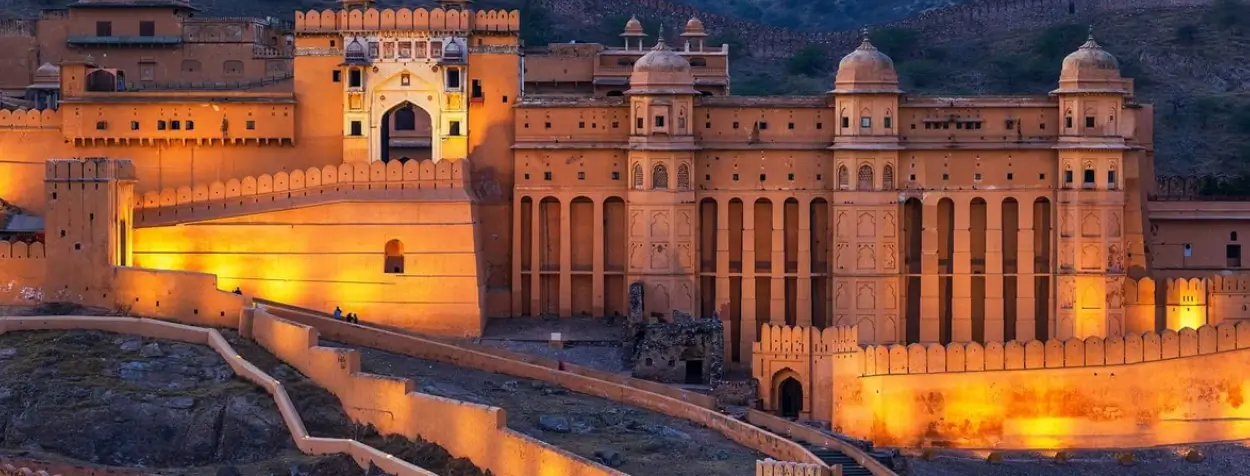
After an early breakfast, you meet your local guide and drive eleven kilometres north of the city to Amber Fort, built in honey-coloured sandstone and white marble on a hill above Maota Lake. You can walk up the ramp to the main gate or ride a jeep to the top. Inside, you pass through four large courtyards, each built by a different ruler, before reaching the Sheesh Mahal, where thousands of small mirror pieces cover the walls and ceiling. Your guide will explain how a single candle once lit the entire hall by reflecting off the glass. On the way back to the city, your driver will stop beside Man Sagar Lake for photos of Jal Mahal, a five-storey palace that appears to float on the water.
Back in the old walled city, often called the Pink City because of its painted terracotta facades, you stop in front of Hawa Mahal, the Palace of Winds. Its honeycomb front has 953 small windows, built so that royal women could watch street festivals without being seen. Next is the City Palace, which is still home to the Jaipur royal family, with museums showing royal costumes, weapons and two giant silver urns listed in the Guinness World Records. Right next door is Jantar Mantar, an eighteenth-century observatory with nineteen huge stone instruments, including a sundial that tells local time to within two seconds. These sights sit close to each other, so the morning moves at an easy walking pace.
After lunch in Jaipur, you begin the drive back to Delhi, which takes around five to six hours with tea stops on the way. Your driver will drop you at your Delhi hotel or directly at Delhi airport in time for an evening or late-night flight. Please share your flight time when booking so the Jaipur sightseeing can be timed around it. This brings your 3 day Golden Triangle tour with Payless Tours India to a close.
Share your details and our travel experts will write back with a tailored itinerary and quote - usually within 24 hours, with no obligation.
Share your query and our team will write back in the shortest possible time with every detail you need.
Tell us when and how you like to travel. We'll send a tailored itinerary within 24 hours - no obligation.
Plan my trip free