
Chand Baori, the stepwell at Abhaneri, drops thirteen levels into the earth on roughly 3,500 narrow steps laid out in a zigzag pattern, yet most visitors on a standard India itinerary drive straight past the turning for it. This golden triangle tour 7 days programme from Payless Tours India puts that stepwell on the map, along with Akbar's abandoned capital at Fatehpur Sikri, and gives you enough time in Delhi, Agra and Jaipur to wait for the right light instead of rushing from gate to gate.
The plan is shaped for people who travel with a camera and an interest in how places were built and lived in. Mornings and late afternoons are kept for the most photogenic sights: the Taj Mahal at sunrise, the river view from Mehtab Bagh at dusk, Hawa Mahal when the first sun hits its facade, and Nahargarh as the city lights come on. Midday hours go to craft workshops, markets and shaded interiors, where your guides explain Mughal and Rajput architecture, inlay work, astronomy and the daily life of the old bazaars.
You stay two nights each in Delhi, Agra and Jaipur, so packing and unpacking is kept to a minimum. A private air-conditioned car with an English-speaking driver covers the whole route, and licensed local guides join you in every city. Hotels can be booked in 3-star, 4-star or 5-star category, and the 7 day Golden Triangle tour can be adjusted around your flights, festival dates or any extra photo stops you want to add.
Each day below has space for a destination photo. Days without an image simply show the description full-width — clean and consistent either way.
A representative from Payless Tours India will be waiting in the arrivals hall of Indira Gandhi International Airport with a board showing your name. After a short welcome, your private air-conditioned car takes you to your hotel, a drive of forty minutes to an hour depending on the time of day and the traffic. Check-in at most Delhi hotels starts in the early afternoon, so if your flight lands in the morning you may want to rest, shower and charge your camera batteries before heading out. Your driver will run through the plan for the week, share his mobile number and confirm a pick-up time for the afternoon walk through the older part of the city.
Around three o'clock you meet your guide at Jama Masjid, the largest mosque in India, completed by Shah Jahan in 1656 in red sandstone and white marble. Its courtyard can hold around 25,000 worshippers, and the broad steps leading up to the east gate are a favourite spot for street portraits as pigeons, food sellers and families pass below. For a wider frame, you can pay a small fee to climb the southern minaret, where the view takes in the domes, the rooftops of Chandni Chowk and the walls of the Red Fort. Visitors are asked to cover arms and legs, and loose robes are handed out at the gate. Photography is allowed, though not during prayer times.
From the mosque, a cycle rickshaw carries you through the narrow lanes of Chandni Chowk, a market laid out in the seventeenth century, where wedding cards, silver, saris and fried snacks are sold side by side. Your guide then leads you on foot into Khari Baoli, the largest wholesale spice market in Asia, where porters carry sacks of dried red chillies, turmeric and cardamom on their heads. A staircase inside the old Gadodia building climbs to a rooftop with a clear view over the lanes, best in the late-afternoon light. If today is not a Monday, when the Red Fort is closed, your guide can add a short walk inside its Lahori Gate. Overnight stay in Delhi.
Your guide collects you soon after breakfast so you reach Humayun's Tomb while the light is still low and the lawns are quiet. Commissioned in 1565 by Hamida Banu Begum for her husband, the second Mughal emperor, it was the first garden tomb on the subcontinent and the first to use red sandstone on such a scale. The double dome, the arched alcoves and the long water channels give strong lines for symmetrical compositions, and the reflections are cleanest before the wind picks up. Inside the complex you will also see the octagonal tomb of Isa Khan, an Afghan noble, which is older than the main mausoleum and sits within its own small walled garden.
A short drive brings you to Lodhi Garden, ninety acres of lawns and old trees where Delhi residents walk, jog and practise yoga each morning. Scattered along the paths are the tombs of the Sayyid and Lodi rulers who governed the city in the fifteenth and early sixteenth centuries, including the Bara Gumbad with its finely carved plaster ceiling. From there you move on to Gurudwara Bangla Sahib, the main Sikh temple of the capital, known for its golden domes and large holy tank. Volunteers in the community kitchen cook lentils and rotis for thousands of people every day, and your guide can take you inside to watch the bread being rolled and the meal served to everyone seated on the floor.
After lunch at a restaurant of your choice, you head south to Qutub Minar, a fluted tower of red and buff sandstone that rises 73 metres and was begun in 1199 by Qutb-ud-din Aibak. Bands of Arabic inscriptions wind around each storey, and a wide-angle lens helps if you stand close to the base. Beside it lies the Quwwat-ul-Islam mosque, built partly with pillars taken from earlier Hindu and Jain temples, and an iron pillar from the Gupta period that has resisted rust for about sixteen centuries. On the way back, you pass India Gate, the war memorial arch, and the long avenue of Kartavya Path leading up to Rashtrapati Bhavan. The evening is free. Overnight stay in Delhi.
After breakfast you check out and leave Delhi on the Yamuna Expressway, a six-lane road that brings the journey to Agra down to around three and a half to four hours. The route passes the new satellite towns of Greater Noida and then opens into wheat and mustard fields, brick kilns with tall chimneys and villages where cakes of cow dung dry in neat stacks against the walls. Your driver can stop at a highway food court for tea or a light snack whenever you like. You should reach Agra around lunchtime and check in at your hotel, leaving a couple of hours to rest before the afternoon light begins to soften and the next part of the day begins.
Mid-afternoon your Agra guide takes you to the tomb of Itimad-ud-Daulah, often called the Baby Taj. Built between 1622 and 1628 by Empress Nur Jahan for her father, Mirza Ghiyas Beg, it was the first Mughal building faced entirely in white marble and among the first to use stone inlay on a large scale. The walls are covered with geometric patterns, cypress trees, wine flasks and flower vases made of coloured stone, while marble lattice screens break the sunlight into soft patterns on the floor. Since far fewer visitors come here than to the Taj Mahal, you can take your time over close-up details and frame the riverside pavilions without crowds walking into the shot.
As sunset approaches, your driver crosses the river to Mehtab Bagh, the Moonlight Garden, first laid out by Emperor Babur and later aligned exactly with the Taj Mahal on the opposite bank. From the riverside edge of the garden you get a clear, open view of the back of the mausoleum, with the Yamuna in the foreground and, on many evenings, buffalo and fishermen wading in the shallows. This is the best place in Agra for a long lens and a tripod, both of which are far easier to use here than inside the Taj complex itself. Once the sky darkens, you return to the hotel, where an early night is a good idea before tomorrow's dawn start. Overnight stay in Agra.
You leave the hotel in darkness to join the queue at the east gate about forty minutes before sunrise. Tripods, drones and food are not allowed inside, so carry just your camera, a spare battery and a memory card in a small bag. Once through the red sandstone Great Gate, the classic view opens up: the long water channel, the cypress-lined paths and the white dome at the far end. In the first hour the marble shifts from blue-grey to pale rose and then to warm cream. Your guide also knows the quieter angles, such as the side arches of the mosque on the western edge, which frame the tomb neatly. The Taj Mahal is closed every Friday, and the tour is arranged accordingly.
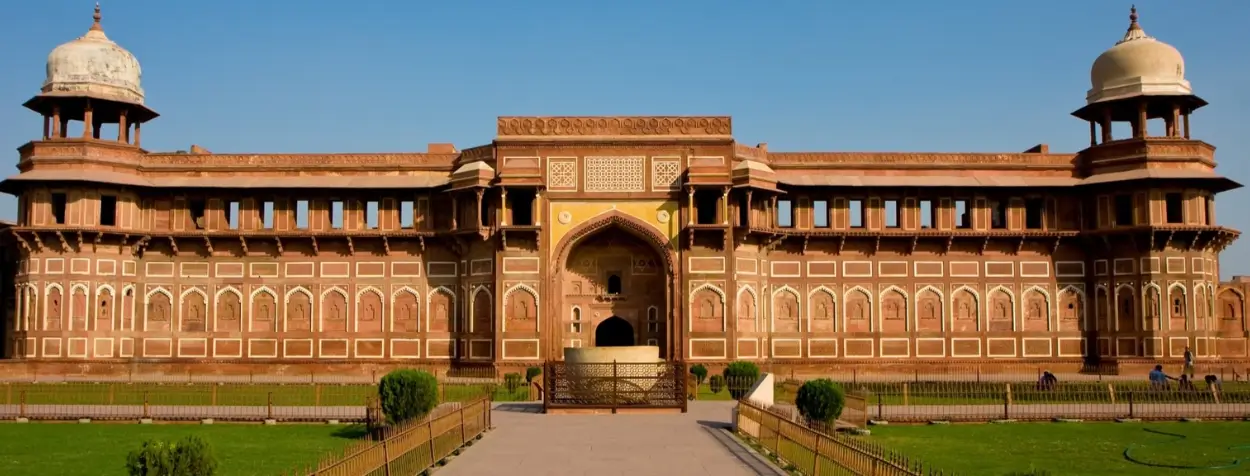
After breakfast back at the hotel, you visit Agra Fort, the red sandstone stronghold on a bend of the Yamuna that Akbar began in 1565 and his grandson Shah Jahan later refitted with marble halls. About two and a half kilometres of walls enclose courtyards, mosques and palaces. Good subjects for photographers include the Amar Singh Gate entrance, the scalloped arches of the Diwan-i-Am and the octagonal Musamman Burj, where Shah Jahan spent his last eight years under house arrest, looking across at his wife's tomb. In the Jahangiri Mahal, look up at the carved brackets and stone beams that copy timber construction, a style borrowed from Gujarat and Central Asia.
In the afternoon, your guide takes you to a family workshop where marble inlay is still made by hand, a craft handed down by artisans who trace their families back to the builders of the Taj Mahal. You can watch them shape tiny pieces of malachite, lapis lazuli and carnelian on a spinning wheel and press them into grooves cut into the marble, and your guide explains how to tell genuine work from cheap copies. There is no obligation to buy anything. Later, if you would like street scenes, a short walk through Kinari Bazaar near Agra's own Jama Masjid offers spice stalls, sweet shops and sellers of wedding goods in the warm evening light. Overnight stay in Agra.
Leave Agra right after breakfast for Fatehpur Sikri, 37 kilometres to the west and reached in about an hour. Emperor Akbar built this walled city of red sandstone between 1571 and 1585 to honour the Sufi saint Salim Chishti, who had foretold the birth of his son and heir. It served as the Mughal capital for only around fourteen years before the court moved on, partly because of a shortage of water. Your guide walks you through the royal enclosure, including the Diwan-i-Khas with its single carved central pillar, the five-tiered Panch Mahal, the courtyard marked out as a giant board for the game of pachisi, and the houses of Akbar's queens.
Next door stands the Jama Masjid, one of the largest mosques of its time, entered through the Buland Darwaza, a victory gateway about 54 metres high that Akbar added after his campaign in Gujarat. Standing on the steps at its base gives a dramatic low angle for a wide lens. In the middle of the courtyard sits the white marble tomb of Salim Chishti, enclosed by screens carved so finely that they look like lace. Visitors of every faith tie red and yellow threads to the lattice while making a wish, and the soft light filtering through the stone makes a lovely subject. Expect a few persistent sellers at the gate; your guide will keep them at a polite distance.
From Fatehpur Sikri the road continues west into Rajasthan, and after about two and a half hours you turn off the highway to the village of Abhaneri. Here lies Chand Baori, one of the deepest and largest stepwells in India, built around the ninth century by King Chanda of the Nikumbha dynasty. Its thirteen levels, roughly 3,500 steps and depth of nearly 20 metres create patterns of light and shadow that change through the day; the steps themselves are closed off, so you view the well from the surrounding galleries. Across the lane stands the Harshat Mata temple, whose broken carved panels still show musicians and dancers. A drive of about two hours brings you to Jaipur by evening. Overnight stay in Jaipur.
Jaipur rewards an early start. Soon after sunrise, the morning sun falls directly on the pink facade of Hawa Mahal, so your guide brings you to a rooftop café across the road for an unobstructed view of its 953 small windows before the street fills with traffic. You then drive north to Amber Fort, the hilltop palace of the Kachhwaha Rajputs, begun by Raja Man Singh I in 1592. Inside are the Ganesh Pol gateway painted with floral designs, the hall of public audience with its double row of columns, and the Sheesh Mahal, whose walls and ceiling are covered in small convex mirrors that catch even the faintest light.
A short drive below Amber lies Panna Meena ka Kund, a sixteenth-century stepwell with crossing staircases on all four sides, which makes a neat contrast to the much older Chand Baori you saw yesterday. Its repeating pattern of stairs looks best from the upper corners, and the mornings are calm before the tour groups arrive. Nearby, the white marble Jagat Shiromani Temple, built in the early seventeenth century, has finely carved elephants and a painted ceiling at its entrance. On the way back towards the city, your driver pulls over at Man Sagar Lake for photographs of Jal Mahal, the five-storey water palace, and then you return to the old city for lunch at a local restaurant of your choice.
The afternoon is spent in the walled Pink City, founded in 1727 by Maharaja Sawai Jai Singh II on a grid plan that was unusual in its day. At the City Palace, the inner Pritam Niwas Chowk has four painted doorways representing the seasons, the peacock gate being the most photographed of them. Next door is Jantar Mantar, an eighteenth-century observatory whose giant sundial casts a shadow that moves about six centimetres every minute, something your guide will show you on the spot. As the day ends, you drive up to Nahargarh Fort on the ridge above the city, where the ramparts give a wide view over Jaipur as the lights come on below. Overnight stay in Jaipur.
After breakfast and check-out, your driver takes you back to Delhi on the national highway, a drive of five to six hours with a tea stop along the way. You will be dropped at your Delhi hotel or directly at Indira Gandhi International Airport in time for your onward flight. Please share your flight details when booking so the departure time from Jaipur can be set correctly.
Share your details and our travel experts will write back with a tailored itinerary and quote - usually within 24 hours, with no obligation.
Share your query and our team will write back in the shortest possible time with every detail you need.
Tell us when and how you like to travel. We'll send a tailored itinerary within 24 hours - no obligation.
Plan my trip free