
The last boat of the day on Lake Pichola leaves the City Palace jetty just as the sun slides behind the Aravalli hills, and for many couples that half hour on the water, with the white palace walls turning gold behind them, is the moment they remember most from India. This golden triangle tour with Udaipur from Payless Tours India adds three nights in the lake city of Mewar to the classic Delhi, Agra and Jaipur circuit, giving honeymooners and couples time to slow down after the busier first half of the trip.
The first four days cover the essential monuments at a comfortable pace: Delhi's Mughal tombs and colonial avenues, the Taj Mahal at sunrise, and two nights in Jaipur for Amber Fort and the old bazaars. On day five you travel from Jaipur to Udaipur by private car, a drive of six and a half to seven hours, or, if you would rather save the time, you can switch to a one-hour flight, which is arranged at extra cost. At the end you fly from Udaipur back to Delhi for your international connection.
Udaipur itself is planned with couples in mind. There is a full morning inside the City Palace, a sunset boat to Jag Mandir island, a candlelit rooftop dinner suggestion at Lal Ghat, a folk dance show at Bagore Ki Haveli and an evening at the hilltop Monsoon Palace. Hotels can be chosen with lake-view rooms on request, and every part of this golden triangle tour with Udaipur can be shifted to suit your arrival date.
Each day below has space for a destination photo. Days without an image simply show the description full-width — clean and consistent either way.
Your driver from Payless Tours India meets you at Delhi airport, holding a sign with your names, and takes you to your hotel to check in and freshen up. If you land early, your guide joins you around midday for an easy introduction to New Delhi. The first stop is Humayun's Tomb, finished in 1570 by order of the emperor's widow, Bega Begum. It was the first great garden tomb in India, and walking its stone paths between square lawns and narrow water channels gives you a feel for the Mughal idea of paradise that later shaped the Taj Mahal. Couples often find the quiet side tombs here a good place for photographs.
A short drive away is Lodhi Garden, a public park where Delhi residents jog, picnic and practise yoga between the tombs of the Sayyid and Lodi dynasties from the fifteenth and sixteenth centuries. It is free to enter and a pleasant place for a slow walk under old trees. Your guide will point out the Bara Gumbad mosque with its painted plaster ceiling and the stone bridge called Athpula, built during Akbar's time. You then pass India Gate and drive along Kartavya Path, where your driver can stop for photos with the arch and the President's House at the far end of the avenue.
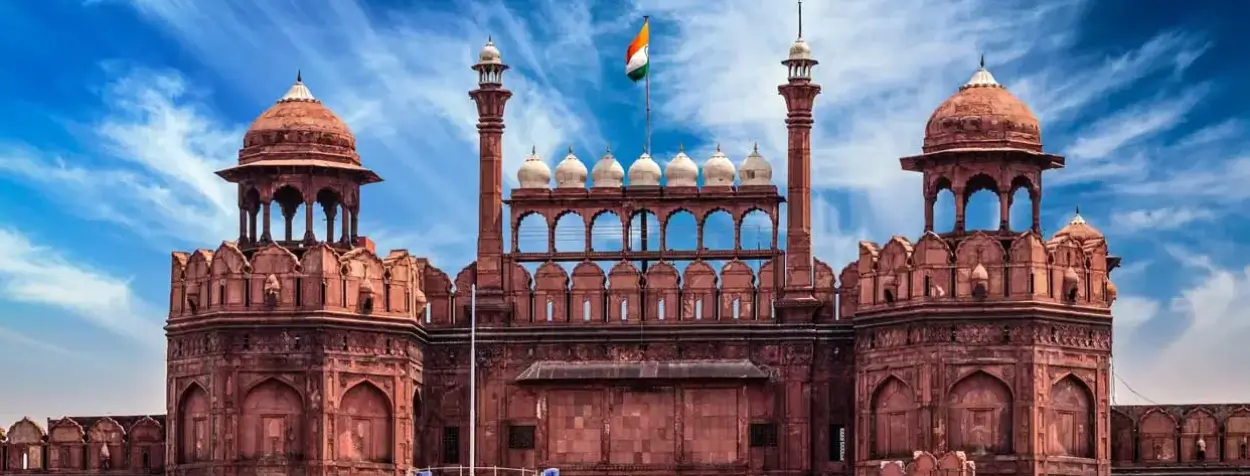
The last visit is Qutub Minar, a 73-metre tower begun around 1199 by Qutb-ud-din Aibak, the first Sultan of Delhi. The bands of carved Arabic verses and the iron pillar, which has stood without serious rust for more than sixteen centuries, are the main points your guide will explain. In the evening, many couples go to Mehrauli, close to the Qutub, where restaurants with terraces look straight onto the lit tower. Your driver can drop you there and collect you later if you wish. Please note that the Red Fort is closed on Mondays if you are hoping to add it. Overnight stay in Delhi.
After breakfast you head south on the Yamuna Expressway towards Agra, a smooth drive of three and a half to four hours. Your driver can stop at a roadside café for coffee and a stretch. On arrival you check in, and in the afternoon your Agra guide takes you to Agra Fort, built by Emperor Akbar on the bank of the Yamuna from 1565. The walls run for about two and a half kilometres. Inside, you pass from the red sandstone palaces of Akbar to the polished white marble rooms added by Shah Jahan, including the Khas Mahal and the Sheesh Mahal, once used by the royal women as a bath house.
The story your guide tells at the Musamman Burj fits well on a couple's holiday. Shah Jahan, who built the Taj Mahal for his wife Mumtaz Mahal, was kept here by his son for eight years, and from this marble balcony he could see her tomb across the river. After the fort you cross the Yamuna to the tomb of Itimad-ud-Daulah, built between 1622 and 1628 by Empress Nur Jahan for her father. It is small, white and covered with inlay of coloured stone, and because fewer tour groups come here it is often peaceful in the afternoon.
Before sunset your driver takes you to Mehtab Bagh, the Moonlight Garden on the far bank of the river, which faces the Taj Mahal directly. From the riverside wall you can see the whole tomb reflected in the water on calm evenings. Many couples choose this spot for portrait photographs, since there are no crowds and the light is warm. Back in the city, you might want to dine at a rooftop restaurant with a view of the Taj Mahal lit softly against the dark sky, or try Mughlai dishes such as murgh musallam or mutton korma at a local restaurant. Rest early tonight, because tomorrow begins before dawn. Overnight stay in Agra.
Your guide meets you at the hotel before first light and walks or drives you to the Taj Mahal entrance about half an hour before the gates open. Arriving early gives you the best chance of a photograph on the famous marble bench with few people behind you. As the sky brightens, the tomb shifts from cool blue to pale pink and then to bright white. Your guide will tell the love story of Shah Jahan and Mumtaz Mahal, who died in 1631 giving birth to their fourteenth child, and explain the twenty-two small domes above the entrance gate, said to represent each year of construction. The Taj Mahal is closed on Fridays.
Inside the tomb the light is dim and the marble feels cool even in summer. You walk past the screen of carved lattice and see the cenotaphs of the emperor and empress side by side, the only part of the whole complex that breaks the perfect symmetry. Outside, your guide will show you how the inlaid flowers glow when a torch is held against the stone, because the marble lets light pass through it. Spend some time on the riverside terrace at the back, where the Yamuna runs past and the view is much quieter than at the front. After about two hours, return to your hotel for breakfast and check-out.
The drive to Jaipur takes four and a half to five hours. You can break the journey at Fatehpur Sikri, the abandoned Mughal capital, or at Chand Baori in Abhaneri, a deep stepwell with thousands of steps arranged in a zigzag pattern. Either stop adds an hour or more. As you enter Rajasthan, you start to see women in bright red and orange odhnis working in the fields and camels pulling carts along the road. You reach Jaipur in the late afternoon. In the evening, take a walk to the Patrika Gate at Jawahar Circle, a colourful painted gateway that is popular for photographs at sunset. Overnight stay in Jaipur.
Begin the day at Amber Fort, a hilltop palace and fortress eleven kilometres north of the city, built from the late sixteenth century by the Kachhwaha rulers. Your guide meets you at the base and you can go up by jeep or walk the stone ramp. Inside, the courtyards rise level by level, from the public hall with its rows of pillars to the private chambers of the king. The highlight for most couples is the Sheesh Mahal, the Mirror Palace, where tiny pieces of glass set into the plaster sparkle with even a little light. Your guide will also show you the zenana, where the queens each had separate rooms around a shared courtyard.
Close to the fort is Panna Meena Ka Kund, a sixteenth-century stepwell with criss-cross flights of steps on all four sides, much loved by photographers. On the drive back to the city you pause at Man Sagar Lake for a look at Jal Mahal, the Water Palace. In the old city your guide takes you to the City Palace, whose seven-storey Chandra Mahal is still the home of the former royal family. Ask to see the Pritam Niwas Chowk courtyard, where four painted doorways show the four seasons; the Peacock Gate is a favourite spot for couple portraits. Next door, the Jantar Mantar observatory holds the world's largest stone sundial.
After lunch, stop outside Hawa Mahal for photographs, then spend the afternoon in the bazaars. Johari Bazaar is the place for jewellery, and many couples buy silver rings or traditional kundan pieces as a keepsake. Bapu Bazaar has embroidered slippers and printed fabrics at modest prices. In the evening, your driver can take you up to Nahargarh Fort on the ridge above the city, where a terrace café looks across the lights of Jaipur as the sun goes down. It is a quiet end to a busy day of sightseeing and a good place for a drink before dinner. Overnight stay in Jaipur.
After an early breakfast, you set off for Udaipur in your private car, a drive of around six and a half to seven hours on the four-lane highway through Ajmer and Bhilwara. If you have chosen to fly instead, your driver will drop you at Jaipur airport for the one-hour flight, and you will be met at Udaipur's Maharana Pratap Airport; this flight is not included in the price and can be booked for you at extra cost. By road, the scenery changes slowly, from the flat plains near Jaipur to the green hills of the Aravalli range as you approach the old kingdom of Mewar.
Your driver will stop for lunch at a highway restaurant around Bhilwara, a town known for its textile mills. As you near Udaipur, marble quarries appear along the road, since this region supplies much of the white stone used in Indian buildings. You arrive in Udaipur in the afternoon and check in at your hotel. If you have asked for a lake-view room, this is a good time to sit on your balcony and rest. Udaipur is a small, easy city, and most of the sights around Lake Pichola are within a short walk or drive of each other.
As the sun begins to set, your driver takes you to Ambrai Ghat on the western shore of Lake Pichola. From here you look straight across the water at the City Palace, with Jag Niwas, now the Taj Lake Palace hotel, floating in the middle of the lake. As the light fades, the palace walls glow orange and then lights come on one by one along the shoreline. Restaurants along this side of the lake offer tables by the water, and many couples choose one of them for their first dinner in Udaipur. Overnight stay in Udaipur.
The morning starts at Saheliyon Ki Bari, the Garden of the Maidens, laid out in the eighteenth century by Maharana Sangram Singh II for the queen and her companions. Fountains imported from England spray water into marble pools, and lotus ponds and kiosks fill the lawns. Your guide will explain that the fountains run on water pressure from Fateh Sagar Lake without any pumps. Next you visit the Vintage Car Museum, which holds the royal family's collection of Rolls-Royces and Cadillacs, including a car used in the James Bond film Octopussy, which was filmed in Udaipur in 1983.
Close by is Fateh Sagar Lake, the second lake of the city, where a road runs along the embankment and boats go out to Nehru Garden island. In the afternoon couples often book a cooking class with a local family, learning to make chapati, dal and a simple curry, or a short couple's spa treatment at their hotel. You may also want to walk around Hathi Pol market, which sells bandhani tie-dye fabrics, leather notebooks and wooden toys at fair prices. Your driver can wait for you or return later, so there is no rush on your last full day in Rajasthan.
Before sunset your driver takes you up the winding road to Sajjangarh, the Monsoon Palace, on a hilltop around five kilometres west of the city. It was built in 1884 by Maharana Sajjan Singh to watch the monsoon clouds roll over the Aravalli hills. From the terrace you can see Lake Pichola, Fateh Sagar and the city spread below, all turning orange as the sun drops. This is one of the best sunset viewpoints in Rajasthan. Afterwards, return to the city for a farewell dinner, perhaps on a rooftop overlooking the lit City Palace, and pack for tomorrow's flight. Overnight stay in Udaipur.
After breakfast your Udaipur guide meets you for a morning at the City Palace, a group of eleven palaces built over nearly four hundred years by the Maharanas of Mewar. It rises above the eastern shore of Lake Pichola and is the largest palace complex in Rajasthan. Inside, narrow stairways lead to the Mor Chowk, the Peacock Courtyard, with three peacocks made of coloured glass mosaic, and the Manak Mahal, which glitters with mirror work. From the upper balconies you have a wide view over the lake. Your guide will explain why the Mewar rulers called themselves the custodians of the kingdom on behalf of Lord Shiva.
Just outside the palace gates is the Jagdish Temple, built in 1651 and dedicated to Lord Vishnu. Its carved stone walls show dancers, elephants and musicians, and you will often hear devotees singing hymns inside. From here, the lanes running down to Gangaur Ghat are full of small art shops selling miniature paintings on paper and silk. Some artists still use fine brushes made from squirrel hair, and couples sometimes order a small portrait painted in the old Mewar style. Lunch can be taken at a café overlooking the ghat, and the afternoon is free to rest at your hotel through the hottest hours.
In the late afternoon you board a motorboat from the City Palace jetty for a sunset cruise on Lake Pichola. The boat passes close to the walls of the Taj Lake Palace and stops at Jag Mandir, an island palace begun in 1551, where Prince Khurram, later Shah Jahan, took shelter during a revolt against his father. You can walk through the island's garden courtyards and see its row of stone elephants facing the water. The boat returns as the sky turns red behind the hills. Later, walk to Bagore Ki Haveli for the Dharohar folk dance show, where women balance clay pots on their heads while dancing. Overnight stay in Udaipur.
After breakfast, your driver transfers you to Udaipur airport for your flight to Delhi, which takes around one hour and twenty minutes. At Delhi airport you can connect directly to your international flight home. The Payless Tours India team wishes you both a safe trip and hopes to welcome you back to India.
Share your details and our travel experts will write back with a tailored itinerary and quote - usually within 24 hours, with no obligation.
Share your query and our team will write back in the shortest possible time with every detail you need.
Tell us when and how you like to travel. We'll send a tailored itinerary within 24 hours - no obligation.
Plan my trip free