
On the steps of Dashashwamedh Ghat, a row of young priests in saffron robes swings heavy brass lamps in slow circles while conch shells sound across the Ganges, and that evening ceremony is the reason this route exists. The Golden Triangle tour with Varanasi from Payless Tours India pairs the Mughal and Rajput monuments of Delhi, Agra and Jaipur with two nights in the oldest living city in India, where pilgrims have bathed, prayed and cremated their dead on the same riverbank for close to three thousand years.
The first four days follow the familiar triangle by private air-conditioned car: a day of contrasts in Delhi, the Taj Mahal at sunrise, and a full day among the forts and palaces of Jaipur. On the fifth morning you are driven back to Delhi airport for a short domestic flight to Varanasi, which is included in the price, so there is no need to arrange tickets separately. Travellers who prefer rail can swap the flight for the overnight Shiv Ganga Express in an AC sleeper berth on request.
In Varanasi the pace changes. You watch the evening aarti from the ghats, float past the burning pyres of Manikarnika in a wooden rowing boat at first light, walk the narrow lanes around the Kashi Vishwanath temple, and spend an afternoon at Sarnath, where the Buddha gave his first sermon. Licensed local guides explain the rituals plainly and respectfully. This golden triangle tour with Varanasi suits anyone curious about the spiritual life of India, not only those who follow it.
Each day below has space for a destination photo. Days without an image simply show the description full-width — clean and consistent either way.
A representative from Payless Tours India meets you at Indira Gandhi International Airport or your Delhi hotel and introduces you to your driver for the next four days. After a short rest, your guide begins with Old Delhi, the walled city laid out by Emperor Shah Jahan in the 1640s. Jama Masjid, the largest mosque in India, has a courtyard that holds around 25,000 worshippers, and from its steps you look straight down into the lanes of Chandni Chowk. Here you board a cycle-rickshaw for a slow ride past spice sellers, silver shops and wedding-card printers. Your guide explains how the market was once divided by a canal that reflected moonlight, which gave it the name Moonlight Square.
Before leaving the old city, you stop at Gurudwara Bangla Sahib, the main Sikh temple in central Delhi. Visitors cover their heads, remove their shoes and walk around a large pool of holy water. The community kitchen, called the langar, serves free vegetarian meals to thousands of people every day, and you are welcome to step inside and watch volunteers rolling chapatis by hand. It is a good first lesson in the way faith and daily service mix in India, a theme that returns later in Varanasi. Your guide will explain the basic beliefs of Sikhism and the history of the eighth guru, Har Krishan, who is linked with this site.
In the afternoon you move to New Delhi. Humayun's Tomb, built in 1570 for the second Mughal emperor, shows the Persian garden design that later guided the plan of the Taj Mahal. You then drive along Kartavya Path past India Gate and the sandstone government buildings of Raisina Hill. If time allows, your driver can add Qutub Minar, the twelfth-century tower of carved red sandstone in south Delhi. Please note that the Red Fort is closed on Mondays, so on that day it is seen only from the outside. Dinner is at your own choice, and your driver can suggest places in Connaught Place or Khan Market. Overnight stay in Delhi.
After breakfast you leave Delhi on the Yamuna Expressway, a toll road that cuts the journey to Agra to around three and a half to four hours. Your driver will stop at a clean highway food court for tea if you need a break. On arrival you check in at your hotel and meet your Agra guide. The first visit is Agra Fort, a great crescent of red sandstone walls built by Emperor Akbar from 1565. Inside you see the white marble halls added by his grandson Shah Jahan, the Diwan-i-Am where petitions were heard in public, and the Khas Mahal with its gilded copper roofs shaped like village huts.
Your guide will lead you to the Musamman Burj, the octagonal tower where Shah Jahan was kept under house arrest by his son Aurangzeb for the last eight years of his life. From its marble balcony he could see the tomb of his wife across the river. Next you visit the tomb of Itimad-ud-Daulah, often called the Baby Taj, a small white marble building on the east bank finished in 1628. It was the first Mughal structure to use inlay of coloured stone on such a scale, and many visitors find its detail more delicate than the larger tomb nearby. Afternoon light here is soft and the gardens are quiet.
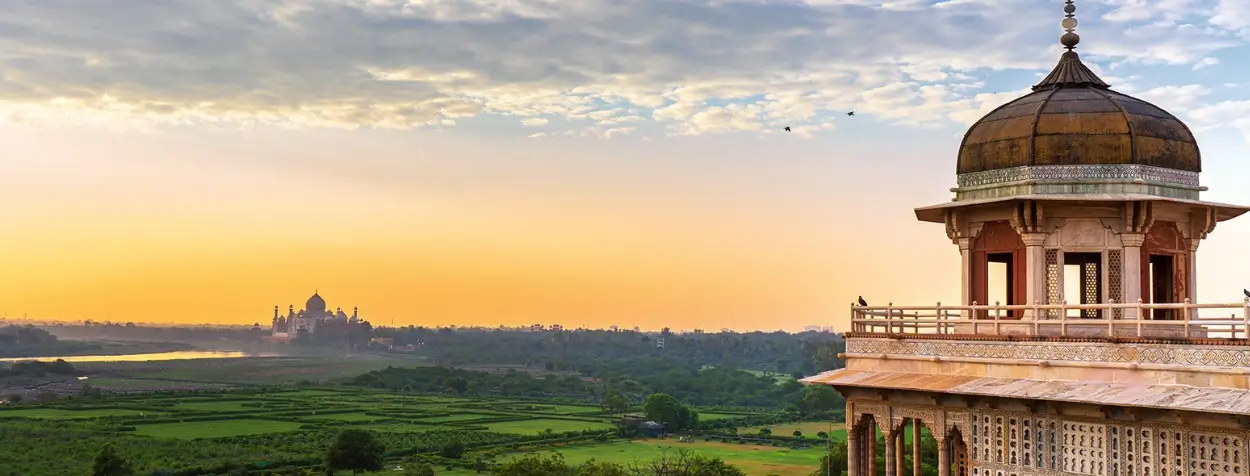
Late in the afternoon your driver takes you to Mehtab Bagh, the Moonlight Garden laid out by Emperor Babur on the north bank of the Yamuna. From here the Taj Mahal sits directly across the water, framed by the river and the fields around it. As the sun drops, the marble turns orange and then grey, and you can watch farmers bringing buffalo down to the riverbank. It is a calm way to see the monument before your full visit in the morning. Back in town, the old Kinari Bazaar stays open late if you want to try petha, the sweet made from ash gourd that Agra is known for. Overnight stay in Agra.
Your guide collects you about forty minutes before sunrise for the short ride to the east gate of the Taj Mahal, where the queue is usually shortest at this hour. You pass through the red sandstone Great Gate and the tomb appears all at once at the end of the long water channel. Your guide will explain the symmetry of the gardens, the calligraphy that grows larger towards the top of the arch so it looks the same size from the ground, and why the four minarets lean slightly outwards. Please remember that the Taj Mahal is closed every Friday, and the tour dates are planned around this.
Inside the main chamber you see the marble screen carved from single slabs, surrounding the cenotaphs of Mumtaz Mahal and Shah Jahan. The real graves lie in a quiet crypt below. Out on the platform, step close to the walls to look at the pietra dura flowers, where carnelian, jasper and malachite have been cut and set by hand. Your guide will also mention the families in Agra who still practise this inlay craft, and you can visit a workshop later if you want to see it done. Allow around two hours in total before returning to your hotel for breakfast, a shower and check-out.
By late morning you are on the road to Jaipur, around four and a half to five hours by car. The route crosses from Uttar Pradesh into Rajasthan, where the land becomes drier and the villages are painted in ochre and blue. Your driver can make a short stop at Fatehpur Sikri, Akbar's red sandstone capital, if you would like to break the drive, though this adds around ninety minutes. You reach Jaipur in the late afternoon and check in at your hotel. In the evening you may want to visit the Birla Mandir, a white marble Hindu temple lit up after dark, or rest before a full day of sightseeing. Overnight stay in Jaipur.
The morning starts at Amber Fort, around eleven kilometres north of Jaipur, built from 1592 by Raja Man Singh, a general in Akbar's army. The fort climbs a ridge above Maota Lake, and you reach the main gate by jeep or on foot along the stone ramp. Inside, your guide leads you through the Diwan-i-Am with its double row of carved pillars, the Ganesh Pol gateway painted with natural colours, and the Sheesh Mahal, where convex mirror pieces cover the ceiling. Look out also for the Sukh Niwas, a hall cooled by water channels that carried breezes through the rooms long before electric fans existed.
On the way back into town you stop by Man Sagar Lake to photograph Jal Mahal, a palace whose lower floors sit under the water. In the old walled city, painted a terracotta pink in 1876 to welcome the Prince of Wales, you stop outside Hawa Mahal and then visit the City Palace, where the royal family of Jaipur still lives in one wing. The museum displays royal clothing, a textile gallery and two silver water jars, each over 1.5 metres high, made to carry Ganges water to England in 1902. Next door, the Jantar Mantar observatory has stone instruments built in the 1720s to track the sun and stars.
The afternoon is free for the bazaars of the Pink City. Johari Bazaar sells silver and gold jewellery, Bapu Bazaar is known for leather sandals called mojaris and block-printed cloth, and Tripolia Bazaar has brass and lacquer bangles. Your driver can take you to a block-printing workshop in Sanganer, where artisans stamp wooden blocks dipped in natural dyes onto cotton by hand. For dinner, many travellers enjoy the dal baati churma, a Rajasthani dish of baked wheat balls served with lentils and sweet crumbled bread. Pack your bags tonight, as tomorrow begins early with the drive back to Delhi for your flight. Overnight stay in Jaipur.
After an early breakfast, your driver takes you from Jaipur back to Delhi, a drive of around five to six hours on the national highway. Instead of going into the city, you are dropped directly at the domestic terminal of Delhi airport, where you say goodbye to your driver. The economy flight to Varanasi takes around one hour and twenty minutes and is included in your package. If you have chosen the overnight train option instead, you will board the Shiv Ganga Express at New Delhi station in the evening and reach Varanasi the next morning, and your sightseeing order will be adjusted to fit.
At Lal Bahadur Shastri Airport in Varanasi, your local representative meets you and drives you around forty-five minutes into the city to check in at your hotel. Late in the afternoon your Varanasi guide walks you towards the river. Cars cannot enter the old part of the city near the ghats, so the last stretch is on foot or by cycle-rickshaw through crowded streets full of cows, flower sellers and pilgrims carrying small brass pots of water. Your guide will explain the basic layout of the city, which stretches along the western bank of the Ganges with more than eighty ghats running down to the water.
You reach Dashashwamedh Ghat in time for the Ganga Aarti, which begins soon after sunset. A row of priests standing on wooden platforms performs the same ritual in perfect time, waving incense, yak-tail fans and many-tiered brass lamps towards the river while bells ring and chants play through speakers. Thousands of people gather on the steps and in boats moored close to the bank. You can also buy a small leaf bowl with a candle and marigold flowers to float on the water. Your guide will explain what each part of the ceremony means. You then walk back through the lanes to your car. Overnight stay in Varanasi.
Before dawn you walk down to the river with your guide and step into a wooden rowing boat for a slow ride along the ghats as the sun comes up over the far bank. This is when the city is most active. Pilgrims stand waist-deep in the water saying morning prayers, washermen beat clothes against stone slabs, and wrestlers train at the akharas near the steps. The boat passes Manikarnika Ghat, the main cremation ground, where fires burn day and night. Your guide will explain why Hindus believe that being cremated here frees the soul from the cycle of rebirth, and will remind you not to take photographs of the funerals.
After the boat ride you walk up into the old city, a tangle of lanes often too narrow for two people to pass. Your guide leads you towards the Kashi Vishwanath temple, one of the twelve Jyotirlinga shrines of Lord Shiva, now reached through a wide new corridor that links it to the river. Security is strict and phones are not allowed inside, so your guide will advise on lockers. On the way, stop at a small shop for a clay cup of hot chai or a bowl of malaiyo, a light saffron milk foam sold only in winter. You then return to your hotel for breakfast and a rest.
In the afternoon you drive about ten kilometres north to Sarnath, where the Buddha gave his first sermon after reaching enlightenment in Bodh Gaya. The Dhamek Stupa, a solid brick and stone tower around 43 metres tall, marks the spot. Nearby you can see the ruins of old monasteries and the base of a pillar raised by Emperor Ashoka in the third century BC. The Sarnath Archaeological Museum holds the original Lion Capital, now the national emblem of India; note that the museum is closed on Fridays. You can also visit the modern Mulagandha Kuti Vihar temple with its wall paintings by a Japanese artist. Overnight stay in Varanasi.
After breakfast, your driver transfers you to Varanasi airport for the included economy flight back to Delhi, which takes around one hour and twenty minutes. On arrival at Delhi, you are met and transferred to the international terminal or a hotel near the airport for your onward journey. Your golden triangle tour with Varanasi ends here with best wishes from the Payless Tours India team.
Share your details and our travel experts will write back with a tailored itinerary and quote - usually within 24 hours, with no obligation.
Share your query and our team will write back in the shortest possible time with every detail you need.
Tell us when and how you like to travel. We'll send a tailored itinerary within 24 hours - no obligation.
Plan my trip free