
Cannonball scars still pit the wall beside Jai Pol, the main gate of Mehrangarh Fort, left there when rival armies besieged Jodhpur in the early 1800s. That kind of detail is what this Golden Triangle with Jodhpur and Udaipur is built around: ten days, six cities and a temple stop, planned as a compact version of Rajasthan for travellers who want more than the three classic cities but cannot spare three weeks. You begin with the Mughal monuments of Delhi and Agra, cross into Jaipur, then head west to the Marwar kingdom of Jodhpur and south through the Aravalli hills to the lakes of Mewar.
The pace is steady rather than rushed. Jaipur, Jodhpur and Udaipur each get at least two nights, so there is time to climb a fort in the morning and sit by a stepwell or a lake in the evening. The long drive from Jodhpur to Udaipur is broken at Ranakpur, where a fifteenth-century Jain temple stands in a forested valley with more than 1,400 carved marble pillars. Licensed local guides join you in every main city, and the same private car and driver stay with you from Delhi airport to Udaipur.
Payless Tours India keeps the end of the trip flexible. On the last day you can take the short flight from Udaipur to Delhi or be driven back in your own car, and either way you are dropped at Delhi airport or your hotel for the flight home. Hotels on this Golden Triangle with Jodhpur and Udaipur can be booked in 3-star, 4-star or heritage-palace category.
Each day below has space for a destination photo. Days without an image simply show the description full-width — clean and consistent either way.
A representative of Payless Tours India will be waiting in the arrivals hall of Indira Gandhi International Airport with a board showing your name. Depending on traffic, the transfer to your hotel takes between forty-five minutes and an hour. If you land early, you can check in, shower and rest before the afternoon tour; standard check-in time at most Delhi hotels is around 2 pm, and an early room can be requested in advance. Your guide meets you in the hotel lobby after lunch, gives you a short overview of the route ahead and hands over a printed itinerary with phone numbers for the driver and the local office.
The afternoon is spent in Shahjahanabad, the walled city that Emperor Shah Jahan founded in the 1640s. You start at Jama Masjid, India's largest mosque, finished in 1656, whose courtyard can hold around 25,000 people at Friday prayers. Shoes are left at the steps, and visitors should cover arms and legs. From the mosque gate you climb into a cycle rickshaw for a slow ride through Chandni Chowk, where wholesale cloth shops, silver jewellers and wedding-card printers fill lanes barely wide enough for two carts. The ride ends at Khari Baoli, a spice market trading since the seventeenth century, where sacks of dried chillies, cardamom and turmeric line the pavement.
On the way out of the old city you pass the sandstone ramparts and Lahori Gate of the Red Fort; note that the fort is closed to visitors on Mondays. A short drive brings you to Raj Ghat, a black marble platform on the bank of the Yamuna marking the spot where Mahatma Gandhi was cremated in 1948. It is a quiet, open lawn where visitors leave flowers. If you are hungry before returning to the hotel, your guide can point you to Karim's, near the mosque's southern gate, a restaurant serving mutton korma and kebabs since 1913. Dinner is at your own expense and choosing. Overnight stay in Delhi.
After breakfast you check out and drive south to Mehrauli to see Qutub Minar before the tour groups arrive. Construction of this five-storey tower began around 1199 under Qutb-ud-din Aibak, the first sultan of Delhi, and was finished by his successors. Each level is ringed by a balcony and bands of carved Quranic verses. Your guide will walk you through the Quwwat-ul-Islam mosque at its base, built partly from the pillars of older Hindu and Jain temples, and to the Alai Darwaza gateway with its pointed arches. The unfinished stump of the Alai Minar, which was meant to be twice as tall, stands nearby and makes a good photograph.
From Mehrauli your driver joins the Yamuna Expressway for the run to Agra, a journey of three and a half to four hours on a wide six-lane road. Food plazas along the route have clean toilets, tea stalls and simple North Indian meals, so lunch on the way is easy. As you approach Agra the scenery shifts to brick kilns, potato fields and the outskirts of a busy leather and marble-working town. After checking in at your hotel, you meet your Agra guide and cross the Yamuna to the left bank, where the older Mughal gardens and tombs line the river away from the crowds.
Your first stop is Itimad-ud-Daulah, built between 1622 and 1628 by Empress Nur Jahan for her father, Mirza Ghiyas Beg. Locals call it the Baby Taj, and it was the first Mughal tomb faced entirely in white marble, with geometric inlay of coloured stones that later reached its peak at the Taj Mahal. The rooms are small, so you can study the wine-cup and cypress patterns up close. Late in the afternoon you walk into Mehtab Bagh, a garden laid out by Emperor Babur, which lines up exactly with the Taj Mahal across the river. At sunset the tomb's reflection appears in the shallow water channels below the garden wall. Overnight stay in Agra.
Your guide collects you before daybreak, and an electric shuttle carries you the last stretch to the eastern gate, as petrol vehicles are not allowed near the monument. The Taj Mahal is closed every Friday, and this tour is arranged so your sunrise visit never falls on that day. Once through the red sandstone Darwaza, you see the tomb framed in the arch, and your guide explains the small tricks the architects used: the Quranic lettering around the entrance grows larger towards the top so it reads evenly from the ground, and the four minarets lean slightly outward so they would fall away from the dome in an earthquake.
Back at the hotel you have breakfast, check out and leave Agra on the Jaipur road. After about forty kilometres you reach Fatehpur Sikri, the city Emperor Akbar built in 1571 to honour the Sufi saint Salim Chishti, who had foretold the birth of his son. The court left within about fifteen years, most likely because of water shortage, so the palaces survive almost untouched. Your guide leads you through the Diwan-i-Khas with its single carved central pillar, the five-tiered Panch Mahal, and the courtyard of the Jama Masjid. Visitors tie a red thread on the marble screens of Salim Chishti's tomb when making a wish, and the 54-metre Buland Darwaza gate towers over the steps.
The rest of the drive to Jaipur takes around four hours across the border into Rajasthan, through Bharatpur district and past the town of Dausa. Camel carts carrying fodder share the road with lorries, and in winter the fields beside the highway turn yellow with mustard flowers. You should reach Jaipur in the late afternoon and check in at your hotel. For an easy first evening, Masala Chowk near Ram Niwas Garden is an open-air food court where well-known street-food sellers from across the city have stalls, offering pyaaz kachori, dal pakwan and kulfi at modest prices. Your driver can take you there and wait. Overnight stay in Jaipur.
The morning starts with the drive out to Amber, eleven kilometres north of Jaipur, which served as the Kachhwaha capital until 1727. Reaching the fort early lets you climb the cobbled ramp before the sun gets strong. Your guide points out Ganesh Pol, the painted gateway that led into the private quarters, its frescoes coloured with natural pigments that have lasted almost four centuries. Inside, Sukh Niwas was cooled by water running through a marble channel in the floor, an early form of air conditioning. From the palace terraces you can trace the long walls of Jaigarh Fort snaking along the ridge above, built to protect Amber from attack.
A five-minute drive from the fort brings you to Panna Meena ka Kund, a square sixteenth-century stepwell where criss-crossing flights of steps run down eight levels to the water. Village women once gathered here to fetch water and talk in the cool shade. Returning to the city, you enter through one of the old gates painted the terracotta colour that gave Jaipur its nickname. The City Palace, where the royal family still lives in one wing, has courtyards that open onto each other in sequence. In Pritam Niwas Chowk, four doorways represent the seasons, with the Peacock Gate standing for autumn and covered in bright painted plaster birds.
Across the road is Jantar Mantar, the observatory Maharaja Sawai Jai Singh II completed in 1734, a UNESCO site since 2010. The Samrat Yantra, a giant sundial 27 metres high, casts a shadow that moves about four millimetres every second, and your guide will show you how to read the local time from it. A short walk takes you to the street side of Hawa Mahal, with its 953 small latticed windows. In the late afternoon your driver takes you up to Nahargarh Fort on the ridge above the city, where the view at sunset covers the whole grid of the walled city and Man Sagar Lake. Overnight stay in Jaipur.
After an unhurried breakfast you leave Jaipur heading west on the national highway towards Ajmer. The first stretch is a wide four-lane road through farmland and marble-processing towns. Near Kishangarh, stone yards stacked with huge white and green marble slabs line the road, as this town is one of the largest marble markets in India. Past Ajmer the highway turns south-west towards Beawar before swinging into Marwar, the old kingdom ruled from Jodhpur by the Rathore clan. Your driver will plan regular breaks, and you can ask him to stop whenever you want to stretch your legs or take pictures.
Somewhere along the way, a roadside dhaba makes a good place for lunch. This is the right part of the country to try dal baati churma, the Rajasthani dish of baked wheat balls served with lentils and a sweet crumbled mixture of wheat, ghee and sugar. As you approach Jodhpur, the land becomes flatter and drier, with thorny khejri trees, goat herds and women in red and orange veils walking between villages. The khejri is sacred to the Bishnoi community, who have protected these trees and the blackbuck antelope living around them for more than five hundred years, and you may spot both from the car window.
You arrive in Jodhpur by mid-afternoon, with Mehrangarh Fort rising on its rock 125 metres above the old city. After checking in, take the evening to walk around the Clock Tower, built by Maharaja Sardar Singh in the late nineteenth century, and Sardar Market, which spreads out from its base. Stalls sell spices, tie-dye fabrics, bangles and silver. Two local snacks are worth trying here: the thick, saffron-flavoured makhaniya lassi from Shri Mishrilal Hotel at the market gate, and the mirchi vada, a large green chilli stuffed with spiced potato and deep-fried in gram flour batter. Overnight stay in Jodhpur.
Your local guide meets you after breakfast for the drive up to Mehrangarh, founded by Rao Jodha in 1459. The approach passes through a series of seven gates. At Jai Pol, built by Maharaja Man Singh in 1806 after a victory over the armies of Jaipur and Bikaner, you can still see the dents left by cannon fire. Just inside Loha Pol, small handprints are pressed into the wall, left by royal widows on their way to commit sati in 1843. Inside the fort museum, the Moti Mahal pearl palace, the gold-ceilinged Phool Mahal and Takhat Vilas, the painted bedroom of Maharaja Takhat Singh, are the highlights.
From the fort's ramparts the old town below looks like a sea of blue cubes. Before walking into it, you drive a short way to Jaswant Thada, a white marble memorial built in 1899 for Maharaja Jaswant Singh II. Its carved marble sheets are thin enough to glow when the sun shines through. Your guide then leads you on foot downhill from the fort into Navchokiya and Brahmpuri, the oldest neighbourhoods, where many houses are painted indigo. One explanation is that Brahmin families first used the colour to mark their homes; another is that lime mixed with blue pigment kept rooms cooler and deterred termites. Expect narrow lanes, sleeping dogs, temple bells and doorways decorated with wedding invitations.
The walk ends near Toorji ka Jhalra, a stepwell commissioned around 1740 by a queen of Maharaja Abhay Singh. For decades it lay filled with rubbish until a restoration project cleared it in the 2010s, and today its carved red sandstone steps drop more than 60 metres down to green water. The surrounding square has cafés with views of the well, a pleasant place for a cold drink or lunch. The rest of the afternoon is free to rest at the hotel. In the evening, many guesthouses and restaurants near the fort have rooftop terraces where you can watch Mehrangarh lit up against the night sky. Overnight stay in Jodhpur.
Leaving Jodhpur after breakfast, you drive south-east across the plains of Pali district for around three and a half hours to Ranakpur. As the road gets closer to the Aravalli range, the dusty landscape gives way to low wooded hills, small reservoirs and fields of wheat and mustard. This area, called Godwar, was a border region between the kingdoms of Marwar and Mewar, and old village forts and step-wells appear along the route. The timing of the drive matters, because the main temple at Ranakpur opens to non-Jain visitors only from noon to 5 pm, and your driver will plan the morning so you arrive at the right time.
The Chaumukha temple was built in 1437 by a Jain merchant named Dharna Shah, on land granted by Rana Kumbha of Mewar, and is dedicated to Adinath, the first Jain tirthankara. It is made almost entirely of pale marble and supported by 1,444 pillars, each carved with a different pattern. Inside, the light changes as you move between 29 halls and around 80 domes. Look for the slab showing Parshvanath beneath a canopy of 108 snake heads, all carved from one block of stone. Leather belts, bags and shoes are not allowed inside, and shoulders and knees must be covered. Photography of the deities is not permitted.
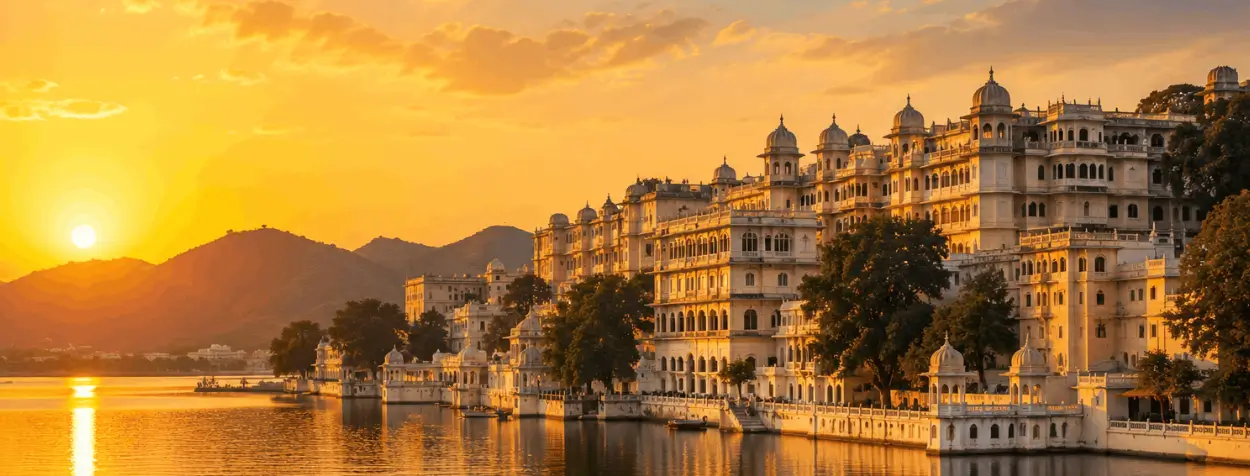
After the temple visit, the canteen run by the temple trust serves a simple vegetarian thali, and the small Surya Narayan sun temple nearby makes a quick additional stop. From Ranakpur the road to Udaipur climbs and twists through the Aravalli hills for about two and a half hours, passing goat herders and villages with whitewashed shrines. You reach Udaipur in the early evening, the old capital of Mewar founded by Maharana Udai Singh II in 1559 after Chittorgarh fell to Akbar. Once you have checked in, the evening is free, and a walk to Ambrai Ghat gives you a first look at the City Palace reflected in Lake Pichola. Overnight stay in Udaipur.
Your Udaipur guide meets you after breakfast for a visit to the City Palace, the largest palace complex in Rajasthan, built and extended over nearly four hundred years by successive Maharanas of Mewar. The museum section winds through narrow staircases and courtyards that were built to slow down attackers. In Mor Chowk, three peacocks are made of thousands of pieces of coloured glass, while the Krishna Vilas has small miniature paintings of royal processions and festivals. From the upper balconies, there are wide views over Lake Pichola, Jag Niwas island, now the Taj Lake Palace hotel, and the white houses of the old town crowding down to the water.
Leaving the palace on foot, you walk a few hundred metres uphill to Jagdish Temple, built in 1651 by Maharana Jagat Singh I and still a working Hindu temple dedicated to Vishnu. A flight of steps flanked by stone elephants leads up to the main shrine, and its outer walls are covered in carvings of dancers, musicians and riders. In the morning you will often hear a group of local women singing devotional songs inside. The lanes around the temple are lined with small shops selling miniature paintings on silk and paper, and your guide can introduce you to an artist who will show you how the fine squirrel-hair brushes are used.
In the late afternoon you board a boat from the City Palace jetty for a ride of about an hour on Lake Pichola. The boat stops at Jag Mandir island, where Prince Khurram, later Shah Jahan, took shelter during his rebellion against his father in the 1620s. After returning to shore, you can attend the Dharohar folk dance performance at Bagore ki Haveli, a restored eighteenth-century mansion on Gangaur Ghat. The hour-long show begins around 7 pm and features Rajasthani puppets, the Ghoomar dance and an elderly performer balancing a tower of brass pots on her head. Tickets are bought at the door. Overnight stay in Udaipur.
This morning you drive about 22 kilometres north of Udaipur into the hills to Eklingji, the temple complex of Shiva as Eklingnath, regarded as the true ruler of Mewar, with the Maharanas acting only as his regents. The current main shrine dates from the fifteenth century, though worship here goes back to the eighth. More than a hundred smaller temples surround it, built in grey stone and marble. Phones and cameras must be left at the entrance, and the temple keeps set darshan hours, which your driver will check in advance. Your guide explains the link between the royal family and the temple, which the Maharana still visits on Mondays.
A few kilometres away, beside the Bagela lake, stand the Saas-Bahu temples of Nagda, a pair of tenth-century Vishnu shrines whose name means mother-in-law and daughter-in-law. The carving on their pillars and ceilings is crisp and deep, with figures of dancers and gods that are worth a close look. Hardly any tourist buses come here, so you can usually take photographs without anyone in the frame. After returning to Udaipur for lunch, you visit Saheliyon ki Bari, an eighteenth-century garden built for the ladies of the court, with lotus pools, marble elephants and fountains that still run on the pressure of water from Fateh Sagar Lake.
In the early evening your driver takes you up the winding road to Sajjangarh, the Monsoon Palace, built in 1884 by Maharana Sajjan Singh on a hilltop west of the city. It was planned as an observatory to watch the monsoon clouds approach, and from its terraces you can see Fateh Sagar, Lake Pichola and the hills of the Aravalli range all at once. The sunset from here is the best in Udaipur, and the palace's pale walls turn orange as the light fades. On the way down, look out for deer in the Sajjangarh Wildlife Sanctuary that surrounds the hill. Your final evening in Rajasthan is free. Overnight stay in Udaipur.
After breakfast and check-out, your driver takes you either to Maharana Pratap Airport, about 25 kilometres from the city, for the direct flight to Delhi, or back to Delhi by road in the same private car if you prefer to drive. Please confirm your choice when booking: the flight ticket is not part of the package, but Payless Tours India can reserve it for you, while the road option leaves after an early breakfast to reach Delhi by evening. On arrival you are dropped at Delhi airport for your onward flight or at your Delhi hotel.
Share your details and our travel experts will write back with a tailored itinerary and quote - usually within 24 hours, with no obligation.
Share your query and our team will write back in the shortest possible time with every detail you need.
Tell us when and how you like to travel. We'll send a tailored itinerary within 24 hours - no obligation.
Plan my trip free