
On the outer wall of the Kandariya Mahadeva temple in Khajuraho, more than eight hundred sandstone figures dance, fight, pray and embrace, carved a thousand years ago by craftsmen whose names nobody recorded. That wall is the centre point of this Golden Triangle with Khajuraho and Varanasi itinerary, a ten-day route designed by Payless Tours India for travellers who care more about temples, carvings and old ritual than about shopping stops. It links the Mughal monuments of Delhi and Agra with the Bundela town of Orchha, the Chandela shrines of Khajuraho, the river ghats of Varanasi and finally the Rajput forts of Jaipur.
Distances in central India are long, so the plan uses the fastest connection for each leg rather than putting you in a car for whole days. A morning express train carries you from Agra to Jhansi, a short drive reaches Orchha, and a scenic road continues to Khajuraho. From there a domestic flight takes you to Varanasi, and another brings you back to Delhi before the final road loop to Jaipur and back.
Each city has its own licensed guide, and the timing follows the light and the ritual calendar: the Taj Mahal at sunrise, the Ram Raja temple at evening prayer, the Ganges by rowing boat before dawn. Hotels are chosen in 3-star, 4-star or 5-star category, with heritage properties available in Orchha and Jaipur. The Golden Triangle with Khajuraho and Varanasi suits first-time visitors with ten days, and repeat visitors who have seen Rajasthan and want the temple country to the east.
Each day below has space for a destination photo. Days without an image simply show the description full-width — clean and consistent either way.
A representative of Payless Tours India meets you in the arrivals hall at Indira Gandhi International Airport, holding a board with your name, and walks you to your private air-conditioned car. The drive to your hotel takes between forty minutes and an hour depending on traffic. After check-in you have time to rest, shower and change before the afternoon programme begins. Your guide arrives at the hotel around two o'clock and runs through the full ten-day route with you, including train and flight timings, so you know what to pack for each section. This is also a good moment to change money, buy a local SIM card or ask any questions about clothing for the temple visits later in the trip.
The afternoon is spent in Shahjahanabad, the walled city that Emperor Shah Jahan laid out in the 1640s. You begin at Jama Masjid, the largest mosque in India, whose courtyard holds up to twenty-five thousand worshippers at Friday prayers. Shoes are left at the steps and robes are provided at the gate if needed. From the eastern stairway you look down on the crowded rooftops and, beyond them, the red walls of the Red Fort. Since the Red Fort is closed on Mondays, your guide may swap its visit to another day if your arrival falls then. Otherwise you walk along its Lahori Gate side and hear how the last Mughal emperor was tried there by the British in 1858.
Next you climb into a cycle-rickshaw for a slow ride along Chandni Chowk and into the narrow side lanes. Kinari Bazaar sells wedding trims and tinsel garlands, Dariba Kalan has silver jewellery shops that have traded from the same doorways for generations, and Paranthe Wali Gali is lined with tiny kitchens frying stuffed flatbreads in ghee. Your guide will suggest which stalls are safe for a first taste of Indian street food. The ride ends near Gurudwara Sis Ganj Sahib, a Sikh shrine on the spot where the ninth Sikh Guru was executed in 1675. In the evening you return to the hotel for dinner at your own pace. Overnight stay in Delhi.
After breakfast you make one stop in New Delhi before leaving the city. Humayun's Tomb, completed in 1570 for the second Mughal emperor, is the first great garden tomb in India and the direct ancestor of the Taj Mahal in plan and proportion. Your guide will show you the double dome, the use of white marble to outline red sandstone, and the char bagh garden cut into four by water channels. The complex also holds the tombs of Isa Khan and the barber's tomb, both quieter corners worth a few minutes. You then pass India Gate and the government avenue of Kartavya Path from the car on your way out towards the Yamuna Expressway, which links Delhi to Agra.
The expressway is a six-lane toll road that runs straight through wheat and mustard fields, so the drive of around three and a half to four hours is smooth and comfortable. Your driver will stop at a clean highway food court for tea or an early lunch. Arriving in Agra early in the afternoon, you head first to Agra Fort, a walled citadel of red sandstone that Akbar began in 1565 and that his grandson Shah Jahan later filled with white marble pavilions. You walk through the Amar Singh Gate, past the Jahangiri Mahal, and into the Khas Mahal, where marble screens look out over the river towards the Taj Mahal two kilometres away.
Later in the afternoon you cross the Yamuna to Itimad-ud-Daulah, often called the Baby Taj. Built between 1622 and 1628 by Empress Nur Jahan for her father, it was the first Mughal tomb faced entirely in white marble, and its walls are covered with inlaid flowers, wine cups and cypress trees in coloured stone. Because few tour groups stop here, it is usually calm, and your guide can explain the inlay technique in detail before you see the larger version at the Taj Mahal tomorrow. The Taj Mahal is closed every Friday, so the dates of your tour are arranged to avoid this. Check in at your hotel and rest before the early start. Overnight stay in Agra.
Your guide meets you in the hotel lobby while it is still dark and walks you to the eastern gate of the Taj Mahal, where the line for security is shortest at opening time. You enter through the red sandstone Darwaza and see the tomb framed by the arch, grey and pale against the morning sky. Over the next hour the marble warms through shades of rose and cream as the sun lifts over the river. Your guide will point out details that most visitors walk past: the Quranic calligraphy that grows larger towards the top so it looks even from the ground, and the four minarets that lean slightly outward, built that way to fall away from the tomb in an earthquake.
After breakfast and check-out, your driver takes you to Agra Cantt railway station for the express train south to Jhansi. Depending on the day and availability, this will be the Gatimaan Express or the Shatabdi Express, both with air-conditioned chair-car seating, reclining seats and a simple meal or snack served on board. The journey takes roughly two and a half to three hours and passes through Gwalior, where you can see the long walls of Gwalior Fort on its rocky plateau from the window. At Jhansi a second private car and driver from Payless Tours India wait on the platform, and the drive to the small town of Orchha on the Betwa River takes only about half an hour.
Orchha was the capital of the Bundela Rajputs from the sixteenth century, and today it is a quiet town of palaces, temples and tombs set among trees. After check-in your local guide takes you through the Raja Mahal and Jahangir Mahal, the second built by Raja Bir Singh Deo to welcome the Mughal emperor Jahangir for a single night. Its domed towers and turquoise tilework still survive on the upper storeys. In the evening you join local families at Ram Raja Mandir for the aarti, where armed police give a gun salute to Rama, who is worshipped here as a reigning king rather than a god. Overnight stay in Orchha.
The morning starts on the riverbank at Kanchan Ghat, where fourteen chhatris, or royal cenotaphs, stand in a row above the Betwa River. Built for the Bundela kings, their spires catch the first sun and reflect in the water, and vultures often nest in the upper niches. Your guide then takes you up the steep staircase of the Chaturbhuj Temple, a tall structure on a raised plinth that was built for an idol of Rama, which according to legend refused to be moved from the queen's palace. From its roof you look across the whole town, the palace complex and the forest beyond. The climb is narrow and dark in places, so comfortable shoes are useful today.
Before leaving you visit the Lakshmi Narayan Temple on a low hill just outside town. Its interior walls and ceilings are painted with murals from the seventeenth to nineteenth centuries, showing scenes from the Ramayana, Krishna stories and even British soldiers in red coats during the 1857 uprising. The paint has faded in patches but the colours of ochre, green and indigo are still clear. Then you begin the drive east to Khajuraho, which takes four to four and a half hours on a two-lane road through the Bundelkhand countryside. Expect villages with mud-walled houses, buffalo carts and fields of soya and wheat, and a lunch stop at a roadside dhaba or highway hotel along the way.
You arrive in Khajuraho in the late afternoon and check in at your hotel, most of which are within a few minutes of the main temple park. Khajuraho is a small, slow village, quite different from the cities you have visited so far, and the evening is free to walk around the lake or sit at a rooftop cafe facing the temple spires. If you want an introduction before tomorrow's tour, there is an evening sound and light show inside the Western Group grounds, narrated in English, which tells the history of the Chandela dynasty using the temples themselves as the screen. Your guide can book tickets on arrival. Overnight stay in Khajuraho.
Your Khajuraho guide meets you after breakfast for the Western Group, the largest and best preserved cluster of the temples built by the Chandela kings between 950 and 1050. Of around eighty-five original temples, about twenty-five remain. You begin at the Lakshmana Temple, whose platform frieze shows hunting scenes, army processions and elephants on the march, then move to the Kandariya Mahadeva, the tallest at thirty-one metres, with its spires rising like a mountain range. Your guide will explain that the famous erotic panels make up less than a tenth of the carving, and that the rest depicts gods, musicians, dancers and everyday life in medieval central India.
Just outside the fenced park is the Matangeshwar Temple, which differs from all the others because it is still in active worship. Inside sits a polished stone lingam more than two metres high, and local villagers come to offer flowers and water throughout the day. Time permitting, your guide will also take you to the Eastern Group, a short drive away, where the Jain temples of Parsvanatha and Adinath carry some of the finest carvings in Khajuraho, including the well-known figure of a woman applying kohl to her eyes. You then return to the hotel to collect your bags before the transfer to Khajuraho airport, about five kilometres from the village.
The flight from Khajuraho to Varanasi takes roughly an hour. Since direct flights on this route are seasonal, Payless Tours India will confirm the best schedule when you book. A Varanasi driver meets you at Lal Bahadur Shastri Airport for the drive into the city of about an hour. After check-in your guide walks you through the lanes to Dashashwamedh Ghat for the evening Ganga Aarti. Seven young priests in saffron robes stand on wooden platforms and swing heavy brass lamps in slow circles while bells ring and conch shells sound. You can watch from the steps or from a boat moored on the river. Overnight stay in Varanasi.
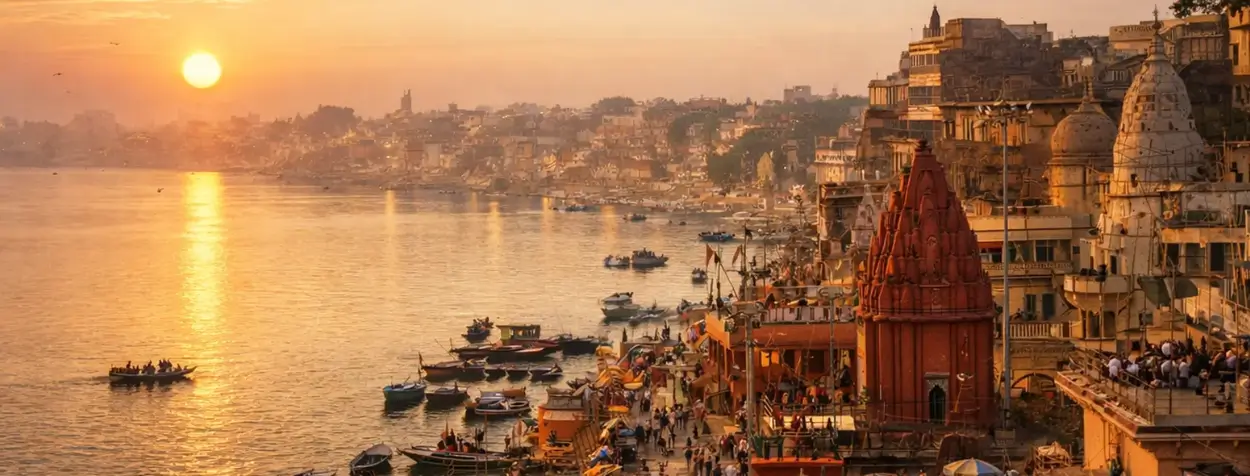
The most important hour in Varanasi is the one before sunrise, so your guide collects you at around five in the morning. You walk down to the river and board a wooden rowing boat for a ride along the curved line of ghats. Pilgrims are already bathing, praying with folded hands and pouring water back into the river towards the rising sun. You pass Manikarnika Ghat, the main cremation ground, where fires burn day and night and where the guide will ask you not to take photographs. Further along you see the palaces built along the riverfront by the rulers of Gwalior, Jaipur and Nepal, many of them now guesthouses.
After the boat ride you walk through the old city, a maze of alleys barely wide enough for a cow and a scooter to pass at the same time. Your guide takes you past small shrines, sweet shops selling malai and kachori for breakfast, and the newly built corridor leading to Kashi Vishwanath Temple, the main temple of Shiva in the city. Non-Hindus may view the temple area from outside, and phones are not allowed inside the corridor, so your guide will advise you. You then return to the hotel for a late breakfast and a rest during the middle of the day, when the heat and crowds on the ghats are at their peak.
In the afternoon you drive ten kilometres to Sarnath, where the Buddha gave his first sermon after reaching enlightenment at Bodh Gaya around 528 BC. The Dhamek Stupa, a solid brick and stone mound forty-three metres high, marks the spot. Nearby are the ruins of monasteries, the stump of a pillar raised by the emperor Ashoka, and the Sarnath Museum, which displays the lion capital that became the national emblem of India. Please note that the museum is closed on Fridays. On the way back your guide may arrange a stop at a silk weaving workshop to see Banarasi saris being made on handlooms. Overnight stay in Varanasi.
After breakfast you have a final morning in Varanasi. Your guide can take you to Bharat Kala Bhavan, the museum inside the campus of Banaras Hindu University, which holds Mughal and Rajput miniature paintings, old textiles and sculpture from across north India. The university campus is green and spacious, a welcome contrast to the old city, and it also contains the large Vishwanath Temple built by the Birla family, open to all visitors. Alternatively, you may prefer another quiet hour on the ghats with a cup of masala chai, watching the washermen, boat repairers and wrestlers who start work near the water each morning.
Around midday your driver takes you to Varanasi airport for the flight to Delhi, which takes about an hour and twenty minutes. Your Delhi car and driver meet you on arrival, and after a short drive to the city your guide joins you for an afternoon visit to Qutub Minar. The seventy-three-metre tower was begun in 1199 by Qutb-ud-din Aibak, the first Sultan of Delhi, and its five storeys of fluted red sandstone and marble are carved with bands of Arabic inscription. In the same complex stands the Quwwat-ul-Islam mosque, built from the pillars of older Hindu and Jain temples, and an iron pillar that has stood for about sixteen hundred years without serious rust.
Later in the afternoon you visit Lodhi Garden, a large park where office workers jog and families picnic around the tombs of fifteenth-century Sayyid and Lodi rulers. It is one of the most pleasant places in Delhi to walk at the end of the day, with tall trees, a small lake and dozens of bird species. If you have energy left, your guide can drop you at Khan Market or Dilli Haat for an evening of browsing crafts from different states before returning to your hotel. Tomorrow's drive to Jaipur starts after breakfast, so it is worth repacking tonight. Overnight stay in Delhi.
After breakfast you leave Delhi for Jaipur on National Highway 48, the route that once linked the Mughal capital with the Rajput kingdoms of the west. The drive takes five to six hours with breaks, and the scenery changes as you cross from Haryana into Rajasthan: the flat farmland gives way to low rocky hills of the Aravalli range, and men in coloured turbans and women in bright odhnis appear in the villages. Your driver will stop at a highway restaurant for lunch, where you can try dal baati churma, the baked wheat balls with lentils and sweet crumble that Rajasthan is known for. You reach Jaipur around the middle of the afternoon.
After check-in your Jaipur guide takes you to the Albert Hall Museum, an Indo-Saracenic building completed in 1887 and set in the gardens of Ram Niwas Bagh. Inside are carpets, arms, metalwork, pottery and an Egyptian mummy, and the building itself, with its domes and arched galleries, is lit up after dark. From here you drive into the walled old city, built in 1727 by Maharaja Sawai Jai Singh II on a grid plan and painted a shade of terracotta pink in 1876 to welcome the Prince of Wales. The guide will explain how the nine blocks of the city were laid out according to the principles of Vastu Shastra.
As evening falls you walk through Bapu Bazaar and Johari Bazaar, the old market streets running beneath the arcades. Bapu Bazaar is known for leather juttis, block-printed cotton and colourful quilts, while Johari Bazaar has been the street of stone cutters and jewellers since the city was founded. Your guide can show you how to spot fair prices and point out the sweet shop of Laxmi Mishthan Bhandar, famous for ghewar and paneer ghewar. You can also stop at Lassiwala on M.I. Road for a clay cup of thick lassi before returning to your hotel. Overnight stay in Jaipur.
After breakfast your guide takes you eleven kilometres north to Amber Fort, which climbs the ridge above Maota Lake in tiers of yellow sandstone. The Kachhwaha kings ruled from here until the court moved down to Jaipur in 1727. You enter through the Suraj Pol, cross the Jaleb Chowk courtyard where soldiers once paraded, and go up to the Diwan-i-Am with its double row of carved columns. The highlight is the Jai Mandir, whose walls and ceilings are lined with convex mirror pieces set in plaster, and the Sukh Niwas next door, where water once flowed through a marble channel to cool the room in summer.
On the way back to the city you stop at the Panna Meena ka Kund, a seventeenth-century stepwell with criss-cross staircases on all four sides, and then at the roadside for a view of Jal Mahal standing in Man Sagar Lake. In the old city you visit the City Palace, where the former royal family still lives in the seven-storey Chandra Mahal. The museum galleries hold royal robes, carpets and weapons, and the Pitam Niwas Chowk courtyard has four doorways decorated for the four seasons, the peacock door being the most photographed. Beside the palace stands Jantar Mantar, with nineteen giant masonry instruments built to measure time and track the stars.
Your final stop is Hawa Mahal, the five-storey screen of pink sandstone that faces the main road of the old city. Instead of just photographing it from the street, your guide will take you inside, where narrow ramps lead up through small chambers to the top levels, and you can look down through the latticed windows just as the royal women did. In the late afternoon you have free time for shopping or tea at a rooftop cafe opposite the palace, from where the sunset turns the whole street orange. This is your last evening of the Golden Triangle with Khajuraho and Varanasi, so it is a good time for a farewell dinner. Overnight stay in Jaipur.
After breakfast and check-out, your driver takes you back to Delhi, a drive of five to six hours with a short break on the way. You are dropped at your Delhi hotel or directly at Indira Gandhi International Airport in time for your onward flight. Please share your flight time in advance so the departure from Jaipur can be planned around it. Payless Tours India wishes you a safe journey home.
Share your details and our travel experts will write back with a tailored itinerary and quote - usually within 24 hours, with no obligation.
Share your query and our team will write back in the shortest possible time with every detail you need.
Tell us when and how you like to travel. We'll send a tailored itinerary within 24 hours - no obligation.
Plan my trip free