
Pushkar has one of the very few temples in the world dedicated to Lord Brahma, the creator in Hindu belief, and the small town of white houses that grew up around it on the edge of the Thar Desert is where this trip turns from sightseeing into something more personal. The golden triangle with Pushkar and Udaipur route from Payless Tours India was put together for independent-minded travellers, backpackers and culture lovers who want the big monuments of Delhi, Agra and Jaipur but also time to wander, sit by a lake and talk to the people who live there.
The plan runs for nine days by private air-conditioned car. You start with the spice lanes of Old Delhi and a Sufi shrine, see the Taj Mahal at sunrise, and spend two nights in Jaipur, including a walk up to the monkey temple at Galta Ji. Then comes Pushkar, with two slow nights for its ghats, the hilltop Savitri temple and a camel cart ride out to the sand dunes at sunset. The trip ends with two nights in Udaipur, where the lanes around Lake Pichola are easy to cover on foot.
Accommodation can be booked in clean, well-reviewed 3-star hotels and family-run heritage guesthouses to keep costs sensible, or upgraded if you prefer. Local guides join you in each city, but there is free time built into most afternoons so you can go off on your own. This golden triangle with Pushkar suits first-time visitors who would rather understand India than simply tick off its sights.
Each day below has space for a destination photo. Days without an image simply show the description full-width — clean and consistent either way.
Your driver from Payless Tours India meets you at Delhi airport or your hotel and helps you settle in. In the afternoon your guide takes you to Old Delhi by metro or car, depending on traffic. You start at the Red Fort, built in 1639 for Shah Jahan; please note it is closed on Mondays, when you see only the outer walls. From there you walk west along Chandni Chowk to Khari Baoli, the largest wholesale spice market in Asia. Porters carry sacks of dried chillies, turmeric and cardamom on their heads, and the air in Gadodia Market is so sharp with pepper that most people start sneezing within minutes.
Your guide will lead you up a narrow staircase to the roof of Gadodia Market, which gives a wide view over the tangle of wires, mosque domes and old havelis of Shahjahanabad. Back at street level, stop for snacks that locals swear by: parathas fried in ghee at Paranthe Wali Gali, or a plate of aloo tikki with tamarind chutney. Then walk to Jama Masjid and climb its southern minaret, if open, for a view back over the Red Fort. This is the kind of slow, street-level wandering the whole trip is built around, so wear comfortable shoes and keep small change handy for tea.
In the early evening you drive to Hazrat Nizamuddin Dargah, the shrine of a fourteenth-century Sufi saint, reached through a lane lined with rose-petal sellers and small kebab stalls. On Thursday evenings, and often on other days too, qawwali singers sit in the courtyard and perform devotional songs with harmonium and hand drums. Visitors of every faith are welcome, though you should cover your head and remove your shoes at the entrance. Your guide will explain the Chishti Sufi tradition and why the poet Amir Khusrau is buried beside his teacher here. Dinner can be at Karim's in Nizamuddin, known for its mutton curries. Overnight stay in Delhi.
After an early breakfast you leave Delhi for Agra on the Yamuna Expressway, a drive of around three and a half to four hours. On the way your driver can point out the turn for Mathura, the birthplace of Lord Krishna, if you are curious about the many temples along this stretch. In Agra you meet your local guide at Agra Fort, a walled royal city of red sandstone started by Emperor Akbar in 1565. Rather than racing through the halls, your guide will help you read the building: the Hindu brackets and carved elephants in Jahangiri Mahal, and the Persian arches of Shah Jahan's later marble rooms.
From the fort, walk or take a cycle-rickshaw into Kinari Bazaar, the old market of Agra that most tourists skip. Lanes here specialise by trade, with one selling wedding trimmings and sequins, another dried fruit, and another shoes, as Agra has made leather footwear for centuries. You can watch petha being cut and boiled in sugar syrup at small family workshops, and try bedai with spicy potato curry, the classic Agra breakfast that is also eaten in the afternoon. Your guide will talk about how the city changed after the Mughal court moved to Delhi and how its craft families have kept going.
In the late afternoon your driver takes you to the Yamuna riverbank near Mehtab Bagh, from where the back of the Taj Mahal can be seen across the water with almost no one around. Fishermen and buffalo herders use this stretch of river, and boys play cricket on the sandbanks. It is a good spot to sit and watch the tomb change colour as evening comes. Back at the hotel, set an early alarm. Your guide will meet you before dawn, and sunrise is the time when the Taj Mahal is at its quietest and the light at its softest. Overnight stay in Agra.
You reach the Taj Mahal gate with your guide before sunrise, ready for security checks as soon as the gates open. Remember that the monument is closed every Friday. Walking through the dark arch of the Great Gate, you see the tomb first as a pale grey shape that warms slowly to rose and cream. Your guide will explain the details people often miss: the black marble verses from the Quran around each arch, the false and real graves, and the way the four minarets were built to tilt slightly outwards so that they would fall away from the tomb in an earthquake. Take time to sit on the lawns and simply watch.
Back at the hotel for breakfast, you check out and set off towards Jaipur. Around forty kilometres from Agra you reach Fatehpur Sikri, the city Akbar built in the 1570s and left within fifteen years, likely because of a shortage of water. Inside the Jama Masjid courtyard you can see the white marble tomb of the Sufi saint Salim Chishti, where visitors tie red threads to the screens while making a wish. The Buland Darwaza, the Gate of Victory, rises 54 metres above the steps. This stop adds around ninety minutes and is well worth the time for anyone interested in the Mughal court.
The drive continues across the border into Rajasthan, through the town of Bharatpur and past fields of mustard and millet. Roadside stalls sell kachoris and sweet milky tea in clay cups, and your driver will know which ones are clean and good. You reach Jaipur by late afternoon. After check-in, take an autorickshaw to the Bapu Bazaar area and walk the old city at dusk, when shopkeepers light incense and the pink walls glow in the last of the sun. For dinner, try laal maas, a fiery Rajasthani mutton curry, or a full vegetarian thali at a local restaurant. Overnight stay in Jaipur.
Your guide meets you early for the short drive to Amber Fort, which sits on a hillside above Maota Lake around eleven kilometres north of Jaipur. Arriving at opening time means you can walk up the ramp before the tour buses arrive. Inside the palace, your guide will explain how the Kachhwaha kings rose to power by allying with the Mughals and how that alliance shows in the mix of building styles. The Sheesh Mahal is the famous part, but ask to see the Sukh Niwas, cooled by water running through channels in the wall, and the maze of narrow passages in the queens' quarters behind it.
Back in the walled city, you do the rest of the morning on foot. Start at the City Palace and the Jantar Mantar observatory, then walk through Tripolia Bazaar and Chandpol Bazaar, where artisans in tiny workshops make lac bangles over charcoal fires, carve marble idols and stitch leather camel saddles. Your guide will explain how the city was laid out in 1727 on a grid of nine blocks according to Vastu Shastra, the old Hindu science of architecture. Stop at Hawa Mahal and climb up through the back entrance to its top floor, which looks down on the street from behind the same small windows used by royal women.
In the late afternoon you drive about ten kilometres east to Galta Ji, a group of temples set in a narrow rocky gorge in the Aravalli hills. Natural springs fill a series of stone pools where pilgrims bathe, and hundreds of macaques and langur monkeys live around the buildings, so keep food out of sight. From the top of the path is the small Surya Mandir, the Sun Temple, with a view over Jaipur as the sun sets. Walk back down in the dusk with the sound of temple bells around you. This is one of the most relaxed and least crowded places in the city. Overnight stay in Jaipur.
After a relaxed breakfast you leave Jaipur for Pushkar on the national highway towards Ajmer, a drive of around two and a half to three hours. Pushkar sits on the far side of a low ridge called Nag Pahar, the Snake Mountain, which separates it from Ajmer. As you come over the pass, the town appears beside its small lake, surrounded by white and blue houses and the sandy hills of the Thar Desert. Your driver will drop you near your hotel or guesthouse, as cars cannot drive into the narrow main bazaar. Please note that Pushkar is a holy town where meat, eggs and alcohol are not sold.
After check-in you walk into the main bazaar, a long lane that curves around the lake and is lined with stalls selling cotton clothes, silver jewellery, leather bags, rose water and incense. This is a good town for backpackers, with cafés serving falafel, lassi and filter coffee alongside traditional Rajasthani food, and plenty of rooftop spots to sit and read. Your guide will explain the origin story of the lake: Lord Brahma is said to have dropped a lotus flower here, and water sprang up where its petals fell, creating Pushkar Sarovar, one of the holiest lakes in India for Hindus.
Towards evening you walk down to the ghats, the fifty-two sets of stone steps that lead into the lake. Remove your shoes before stepping onto them. Priests may offer to perform a small puja for you, and if you accept you should agree on a donation beforehand; your guide will help with this so there is no confusion. At Varaha Ghat or Gau Ghat, the evening aarti begins at sunset with bells, drums and burning lamps reflected in the water. Pigeons wheel overhead and sadhus with long dreadlocks sit on the steps. Later, a rooftop café is a peaceful spot for a thali dinner. Overnight stay in Pushkar.
Your guide meets you after breakfast for a visit to the Brahma Temple, believed to date back to the fourteenth century in its present form, although the site is much older. It is one of the very few temples in India dedicated to Brahma, and your guide will tell you the legend of the curse placed on him by his wife Savitri, which explains why he is not widely worshipped elsewhere. The temple has a red spire, a marble floor set with silver coins left by devotees, and a silver turtle facing the shrine. Leather items, cameras and phones may need to be left outside, so travel light this morning.
Late in the morning, or in the cooler afternoon in summer, you walk or take the ropeway up to the Savitri Temple, perched on Ratnagiri hill south-west of town. The steep stone path has around six hundred steps and takes forty minutes to an hour on foot; the ropeway does it in a few minutes. At the top, the small shrine to Brahma's first wife looks out over the lake, the town and the desert plains stretching west. On a clear day you can see the Aravalli ridges in the distance. Many backpackers choose to climb at dawn instead, so mention this to your guide if you would like to change the order.
In the afternoon you set off on a camel cart ride into the sand dunes on the edge of Pushkar. The wooden cart has a padded seat and is pulled by a single camel at a slow, rocking pace past farms and small hamlets. The ride takes around two hours, and you stop in a settlement of the Raika herders, where you can share sweet tea and learn about their life with camels and goats. The sun sets over the dunes before you return to town. If you visit in October or November, ask about the Pushkar Camel Fair, held during the Hindu month of Kartik. Overnight stay in Pushkar.
After breakfast you leave Pushkar for Udaipur, a drive of around five to five and a half hours on the four-lane highway through Ajmer, Bhilwara and Chittorgarh district. The landscape changes along the way from desert scrub to farmland and, finally, to the forested hills of the Aravalli range around Udaipur. Your driver can stop at a dhaba for lunch, where dal, paneer curry and tandoori rotis are made fresh. If you would like a longer break, a short detour to the fort of Chittorgarh is possible on request, though it adds around three hours and makes for a long day.
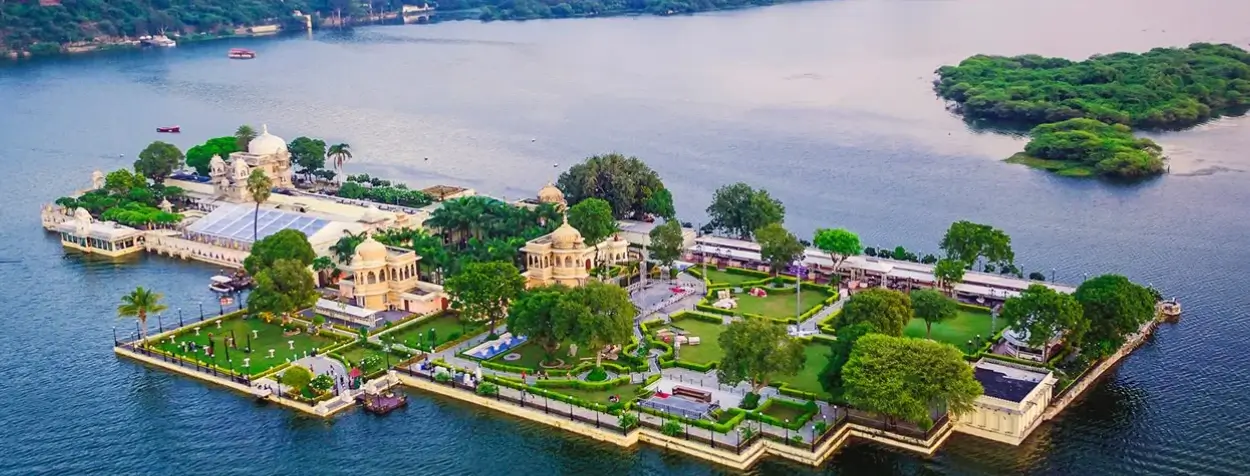
You arrive in Udaipur in the mid-afternoon and check in at your hotel or haveli guesthouse, many of which are tucked into the old lanes near Lal Ghat with rooftop views of the lake. After a rest, walk down to Gangaur Ghat and cross the small Chandpole bridge to the Hanuman Ghat side of the lake. This is the more relaxed half of the old city, with cheaper cafés, book exchanges and art schools offering short miniature painting lessons. Your guide will explain how Udaipur was founded in 1559 by Maharana Udai Singh II after Chittorgarh fell to Akbar's army.
As the light softens, find a spot on the steps of Hanuman Ghat or a rooftop terrace and watch the sun go down behind the hills on the far shore of Lake Pichola. Women wash clothes on the ghats, boys dive into the water and the City Palace across the lake turns a warm cream colour. In the evening, Bagore Ki Haveli on Gangaur Ghat hosts the Dharohar show of Rajasthani folk dance and puppetry, which starts at around seven o'clock and lasts an hour. It is a lively introduction to the music of Mewar. Dinner can be at one of the many lakeside cafés in the old town. Overnight stay in Udaipur.
Your Udaipur guide meets you in the morning at the City Palace, a sprawling complex of courtyards, balconies and towers built by successive Mewar rulers from the sixteenth century onwards. Inside, the museum displays weapons, palanquins and miniature paintings of royal hunts and festivals. Look for the armour of Maharana Pratap, the Mewar king who fought Akbar's army at the Battle of Haldighati in 1576 and is still a local hero. The Mor Chowk courtyard with its glass mosaic peacocks is the most photographed spot, but the quieter Zenana Mahal, now a picture gallery, is often more interesting.
Just above the palace stands the Jagdish Temple, built in 1651, which you reach by a steep flight of steps guarded by stone elephants. After the visit, your guide takes you a few kilometres east of the city to the Ahar cenotaphs, the royal cremation ground of the Mewar kings, where more than two hundred white domed chhatris stand in rows. Few tourists come here, and it is a calm place to sit. Close by, the Ahar Museum holds pottery and copper objects from a settlement nearly four thousand years old, showing how long people have lived in this valley.
The afternoon takes you to Shilpgram, an arts and crafts village around three kilometres west of Fateh Sagar Lake. It is laid out as a set of traditional huts from Rajasthan, Gujarat, Goa and Maharashtra, and craftspeople demonstrate pottery, weaving and embroidery. Folk musicians and dancers perform in the open spaces, and you can buy handmade items directly from the makers. On the way back, walk along the Fateh Sagar embankment, where locals gather in the evening for corn on the cob and cold coffee. Spend your last night in the old town, perhaps at a rooftop restaurant facing the lit palace. Overnight stay in Udaipur.
After breakfast your driver transfers you to Udaipur's Maharana Pratap Airport, around forty minutes from the city, for your flight to Delhi. The flight takes around one hour and twenty minutes, and you can connect to your international departure from there. Your golden triangle with Pushkar and Udaipur trip ends here, with thanks from everyone at Payless Tours India.
Share your details and our travel experts will write back with a tailored itinerary and quote - usually within 24 hours, with no obligation.
Share your query and our team will write back in the shortest possible time with every detail you need.
Tell us when and how you like to travel. We'll send a tailored itinerary within 24 hours - no obligation.
Plan my trip free