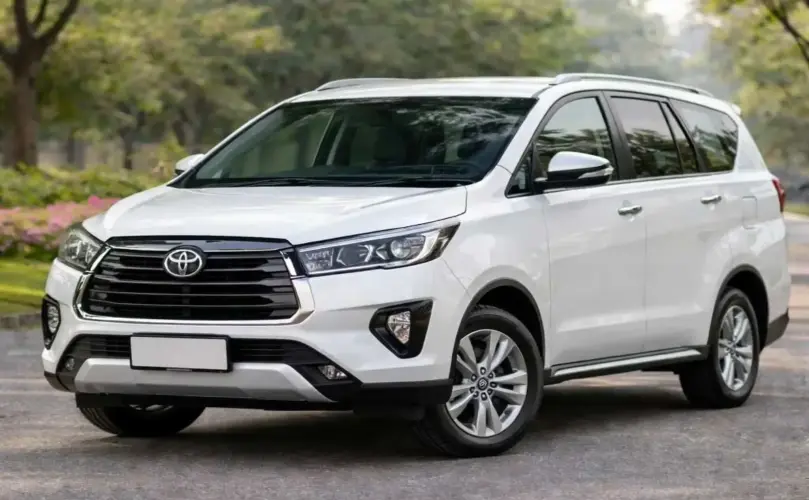
At 1:40 am a British Airways flight from London rolled up to its gate at Terminal 3. Forty minutes later Helen and Mark Davies, a retired couple from Manchester, pushed two heavy suitcases through the sliding doors into warm, hazy air and a wall of faces. Hundreds of drivers stood behind the steel barrier, many holding paper signs. Mark later admitted that his heart sank for a second, until he spotted a white board with "DAVIES, MANCHESTER" written in neat blue capitals. Rakesh, their driver, took the trolley, walked them to an Innova Crysta in the car park and had them at their hotel in Connaught Place before 3 am.
That short, calm ride is what a good private airport transfer is supposed to buy you after a nine-hour flight. This guide sets out what such a ride actually costs in Delhi, how the pickup works at Terminal 1, 2 and 3, what goes on the bill beyond the basic fare, and how a pre-booked car compares with the prepaid taxi counter and app cabs. We also cover the two small jobs worth doing before you leave the terminal: a local SIM card and some Indian rupees.
Indira Gandhi International Airport, almost always shortened to IGI, has three passenger terminals, and the one printed on your ticket changes where your driver stands. Terminal 3 arrivals is where nearly every foreign visitor lands. It handles all international flights, plus Air India and some other domestic services, and it is the largest and busiest building of the three. Terminal 1 is a separate domestic terminal on the far side of the runways, used mainly by IndiGo, SpiceJet and Akasa. Terminal 2 sits next to Terminal 3 and handles domestic flights when it is in use, though it has been through renovation work, so check your onward ticket carefully. The drive between Terminal 1 and Terminal 3 takes 20 to 30 minutes, which matters if you connect to a domestic flight later.
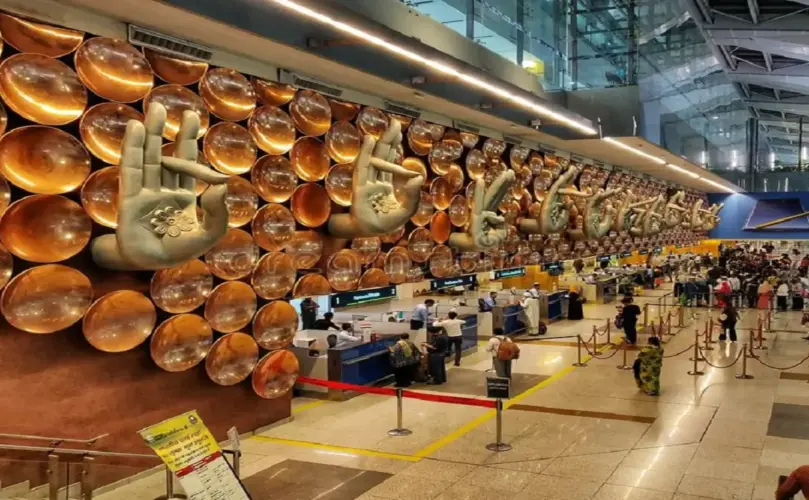
At Terminal 3 the routine runs in a fixed order. You clear immigration, collect bags from the belt, walk through customs on the green channel if you have nothing to declare, and pass through the arrival hall. The hall has the currency counters, ATMs, SIM card desks and a few coffee shops. Only passengers are allowed inside this hall, so your driver cannot come in to find you. Once you walk out of the exit doors you are in the open forecourt, and that is where the meet-and-greet at Delhi airport happens.
Drivers and hotel staff wait behind a long barrier directly opposite the exit gates. Good operators send the driver early and ask him to stand near a numbered pillar, so the name board is easy to spot. A clear driver with a name placard is worth more than people think. At 2 am, when 40 people are holding signs and calling out "taxi", a large printed board with your surname and home city cuts the search to seconds. We always send the driver's name, mobile number and a photo of the car on WhatsApp the evening before, and the driver messages again once your flight shows as landed.
From the barrier the driver walks with you to the car, which waits in the multi-level car park or a nearby pickup lane, because private cars are not allowed to stand at the kerb for long. The walk is about five to ten minutes with a trolley, and the driver should push it for you. Lifts and ramps make it manageable with heavy bags. At Terminal 1 the arrangement is similar but smaller, and drivers wait just outside the arrival exit.
One safety point matters. Nobody from a genuine operator will approach you inside the terminal or ask you to follow them before you see your name on a board. If someone says your driver "is waiting outside, come with me", politely decline, walk to the barrier and call the number you were sent. Touts at Delhi airport have become rarer, but tired travellers remain an easy target.
Book Your Private Delhi Airport Transfer
Start your India trip with a comfortable, convenient airport pickup. Whether you're heading to a Delhi hotel, planning local sightseeing or continuing to another city, arrange a private car to suit your schedule and travel requirements.
The fare for a pre-booked car depends on three things: the car, the distance and the time of day. Drive times from Terminal 3 can double between a quiet 3 am run and a 6 pm weekday rush, so most operators charge a fixed transfer rate instead of a metered fare. The figures below are honest, higher-side market rates for a private car with a uniformed driver, clean vehicle and meet-and-greet included.
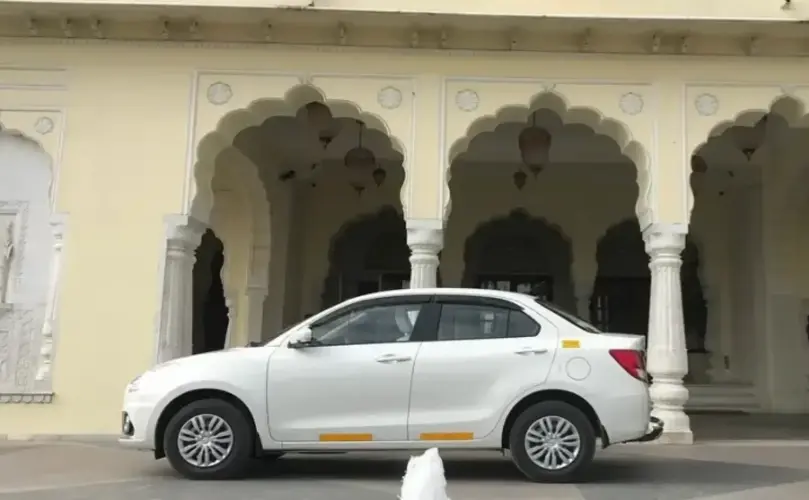
Aerocity hotels near Delhi airport form the cluster next to the terminals, about 5 km and 10 to 15 minutes from Terminal 3. It holds the JW Marriott, Andaz, Pullman, Novotel, Holiday Inn and Roseate House, and many long-haul passengers stay here for one night. A sedan airport transfer in Delhi there, in a Swift Dzire or Toyota Etios, costs about INR 2,000 to 2,300 (USD 24-27). An Innova Crysta airport pickup to the same hotels is INR 3,000 to 3,400 (USD 35-40). It sounds a lot for 5 km, but you are paying for the driver's waiting time, parking and the car's whole trip from base.
Connaught Place and Paharganj are 16 to 18 km from Terminal 3, usually 35 to 60 minutes by road. Connaught Place has hotels such as The Imperial, The Park and Radisson Blu Marina, and Paharganj has the budget and mid-range hotels near New Delhi railway station. A sedan costs about INR 2,400 to 2,800 (USD 28-33) and an Innova Crysta INR 3,400 to 3,800 (USD 40-45). Paharganj's lanes are narrow, so on some streets the driver may stop at the corner and carry your bags the last 100 metres.
Gurugram is around 15 to 25 km away, depending on whether you stay at Cyber City, Golf Course Road or Sohna Road. The Leela Ambience, Oberoi Gurgaon and Trident are the usual names here. Expect INR 2,600 to 3,200 (USD 31-38) in a sedan and INR 3,600 to 4,200 (USD 42-49) in an Innova Crysta. Noida is the longest local run at 35 to 45 km and 60 to 90 minutes, so a sedan costs INR 3,000 to 3,600 (USD 35-42) and an Innova INR 4,000 to 4,800 (USD 47-56).
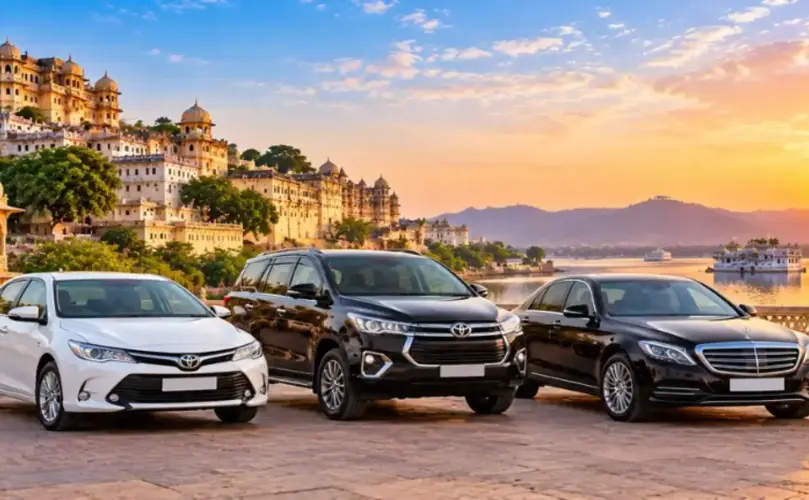
For more space or more comfort, the prices step up. A Tempo Traveller for a group of six to nine people with heavy luggage costs INR 5,500 to 7,500 (USD 65-88) to central Delhi. A Mercedes airport transfer in Delhi in an E-Class with a chauffeur in a suit is INR 7,500 to 10,000 (USD 88-118), and a BMW 5 Series or Audi A6 sits at a similar level. A Mercedes S-Class or BMW 7 Series for a business traveller runs INR 15,000 to 22,000 (USD 176-259) one way.
These fares normally include the car, fuel, driver, meet-and-greet with a placard and help with luggage. GST at 5% on transport is sometimes included and sometimes added at the end, so ask. Airport parking, night surcharges and long waits are the extras covered in the next section. At Payless Tours India we quote the full figure in writing, so the price on the voucher matches the price you pay.
A large share of long-haul flights from Europe, North America and Australia land in Delhi between 11 pm and 5 am. That is cheap for airlines and awkward for passengers, and it is also when most extra charges kick in. The most common one is the night surcharge for airport transfers. Many operators add about 25% to the base fare for pickups between 11 pm and 6 am, which turns a INR 2,800 sedan fare into roughly INR 3,500 (USD 41). Some charge a flat INR 300 to 500 instead. Either is fine, but the charge should be written on your quote before you pay, not announced in the car.
Then there is airport parking for the pickup car. The driver has to park in the official car park while he waits for you, and the airport bills by the hour. For a normal arrival the charge comes to INR 150 to 350 (USD 2-4), depending on how long he waits. Most operators pass this on at cost, and a good driver will show you the paper parking ticket. A few roll it into a fixed fare, which is simpler. It is a small sum and should never be inflated.
The flight delay waiting policy is where the fine print really matters. The usual rule is that the driver tracks your flight number and the clock starts at the actual landing time, not the scheduled one. If your Qantas flight from Sydney is three hours late, the driver simply comes later, and there is no charge for that. After landing, most operators allow free waiting time at Delhi airport of 60 minutes, which covers immigration, bags and customs on an average night. Immigration at Terminal 3 can take anything from 15 minutes to over an hour when several wide-body flights land together, and baggage often adds another 20 to 30 minutes.
Beyond that free hour, waiting is billed at INR 300 to 500 (USD 4-6) per hour. Lost-bag paperwork is the usual reason travellers go over. If you are stuck at the baggage services desk filling in a report, message the driver on WhatsApp from the free airport Wi-Fi, so he knows you have not vanished. Many operators waive the first extra half hour when they know the reason.
A few other items appear less often. Tolls are rare inside Delhi, though a Noida drop may include a small one. A drop at a second address, such as a friend's house after the hotel, is usually INR 300 to 600 extra. A child seat, which is not standard in Indian cars, costs INR 500 to 800 if your operator can arrange one, and you should ask at least two days ahead. Cancellation terms differ too, but 24 hours' notice for a full refund is common for airport transfers.
The key point is that each of these charges is reasonable on its own, and none should arrive as a surprise. A clear airport transfer quote lists the base fare, GST, the night rule, the free waiting time, the waiting rate and parking. If any line is missing, ask before you pay.
Travel from Delhi Airport to Your Hotel in Comfort
Skip the stress of arranging transport after landing. Organise a private car from Delhi Airport to your hotel or preferred address. Request a quote based on your destination, arrival time and vehicle requirements.
There are three common ways out of Terminal 3, and each suits a different kind of traveller. The first is the prepaid taxi counter at Delhi airport, run under the Delhi Traffic Police system and found in the arrival hall and just outside it. You give your destination, pay a fixed fare at the window and receive a slip with the car number. Fares to Connaught Place in a basic car are roughly INR 500 to 800 (USD 6-9), much cheaper than a private transfer. The cars, however, are often older hatchbacks or small sedans with limited boot space, air conditioning can be weak, and drivers rarely speak much English. For a backpacker with one rucksack it works. For a couple with two large suitcases at 2 am, it can feel like a gamble.
The second option is an app cab such as Uber or Ola from Delhi airport. Fares to central Delhi usually come to INR 600 to 1,200 (USD 7-14), with surge pricing at busy times. The cars are generally newer and the price shows up front. The problems are practical. Your home SIM may not work on arrival, international roaming is costly, and the airport Wi-Fi requires an OTP sent to a phone number. App pickups at Terminal 3 are from a dedicated zone in the car park area, which means a walk with your trolley, and finding the right car among hundreds of white sedans is slow at night. Drivers sometimes call to ask your destination and then cancel, leaving you to start again. Some app cars also cannot take three large suitcases.
The third route is the pre-booked private car. It costs more, roughly three to four times a prepaid taxi, but jet-lagged foreign travellers get things that matter. Someone is waiting with your name, the car is clean and the size you asked for, the driver can take a card or cash payment set in advance, and there is a human being to call if your flight changes. For first-time visitors, families with children, older travellers and anyone landing between midnight and dawn, the extra INR 1,500 to 2,500 is usually money well spent.
A useful middle path is to book the airport car as day one of a longer private car with driver from Delhi airport package. If you are heading on a Golden Triangle trip, the same car and driver can collect you, drop you at the hotel and return the next morning for Delhi sightseeing. Many operators price the airport pickup much lower, or include it free, when it is part of a multi-day booking, because the car is already allocated to you.
The choice comes down to timing and luggage. A traveller landing at 11 am with one bag, a working eSIM and a short hop to Aerocity can save money with an app cab. A family of four landing at 3 am with five suitcases and no Indian SIM is better off with a named driver standing at the barrier.
Two small jobs are easiest inside the Terminal 3 arrival hall, before you meet your driver. The first is a phone connection. Airtel and Vi (Vodafone Idea) have desks in the hall, and a tourist SIM card at Delhi airport costs around INR 500 to 1,200 (USD 6-14) for a 28-day pack with daily data and some local calls. Staff need your passport, your Indian visa or e-Visa printout and sometimes a passport photo, and they take a live photo at the desk. Activation can take anywhere from 30 minutes to a few hours. Airport rates are higher than in the city, but the convenience is real. An eSIM bought online before you fly is another option, and many travellers from the US, UK and Australia now go that way.
The second job is cash. Currency exchange at Delhi airport is available from counters in the arrival hall, but rates are poor, often 5% to 8% worse than in the city. A better approach is to change only a small amount, say USD 50 to 100, or use one of the bank ATMs in the hall with a debit card. Withdrawing INR 10,000 (USD 118) covers tips, small purchases and the first day or two. Cards work in hotels, restaurants and malls, while monument kiosks, small shops and drivers often prefer cash or UPI, which visitors cannot easily use without an Indian bank account.
Tipping your driver is not compulsory, but INR 200 to 300 (USD 2-4) for an airport run is a kind gesture, especially after a long wait or a heavy lift. If the driver is going to stay with you for a multi-day tour, the usual practice is to tip at the end of the trip rather than at the airport.
Before you pay for any transfer, check a handful of things in writing. The quote should name the car model, not just "sedan" or "SUV", because a Swift Dzire and a Toyota Etios have different boot sizes. It should say whether GST is included, what the night surcharge is and from what hour, how many minutes of free waiting you get, the hourly rate after that, and whether airport parking is included or added at cost. Ask for the driver's name and mobile number at least 12 hours ahead, and share your flight number so he can track it. A good operator will also give you an office phone number that is answered at 3 am.
Finally, keep a photo of your booking confirmation on your phone and a paper copy in your hand luggage. If your phone dies on the flight, the paper copy with the driver's number and the hotel address is all you need to sort things out at the barrier.
Everything foreign travellers usually ask before booking a Rajasthan tour. Still unsure? Just send us a message.
Ask a questionA sedan such as a Swift Dzire or Toyota Etios costs about INR 2,400 to 2,800 (USD 28-33) from Terminal 3 to Connaught Place. An Innova Crysta costs INR 3,400 to 3,800 (USD 40-45). Add about 25% between 11 pm and 6 am, plus 5% GST if it is not already included.
Drivers wait behind the barrier directly outside the arrival exit gates at Terminal 3, holding a name board. They cannot enter the arrival hall, so walk out through the exit doors after customs and look for your name. Your operator should send the driver's mobile number and a pillar or gate number in advance.
The driver tracks your flight number and arrives for the actual landing time, so a late flight costs nothing extra. Most operators then give 60 minutes of free waiting after landing. After that, waiting is usually INR 300 to 500 (USD 4-6) per hour.
Yes, most operators add a night surcharge for pickups between 11 pm and 6 am. It is usually about 25% of the base fare, or a flat INR 300 to 500. Make sure the charge is written on your quote before you pay.
The airport bills the pickup car by the hour while the driver waits in the official car park. The charge is usually INR 150 to 350 (USD 2-4) and is either added at cost or built into a fixed fare. Ask your operator which method they use.
The prepaid taxi counter run under the Delhi Traffic Police system is a legitimate and generally safe option, with fixed fares of about INR 500 to 800 to central Delhi. The cars are often small and basic, and drivers may speak limited English. Families with heavy luggage arriving late at night are usually more comfortable in a pre-booked car.
Yes, Uber and Ola operate from a dedicated pickup zone near the Terminal 3 car park. Fares to central Delhi are roughly INR 600 to 1,200 with surge pricing at busy times. You need a working phone connection, and the walk to the pickup zone with a trolley can take 10 minutes or more.
Aerocity is about 5 km from Terminal 3, a 10 to 15 minute drive in normal traffic. A sedan transfer costs about INR 2,000 to 2,300 (USD 24-27) and an Innova Crysta about INR 3,000 to 3,400 (USD 35-40). It is a popular choice for one night after a late international arrival.
Airtel and Vi (Vodafone Idea) have desks in the Terminal 3 arrival hall before you exit. A tourist SIM with a 28-day data pack costs about INR 500 to 1,200 (USD 6-14). Bring your passport and visa printout, and allow 30 minutes to a few hours for activation.
Change only a small amount at the airport, because rates are often 5% to 8% worse than in the city. Using a bank ATM in the arrival hall is usually better value. Withdrawing about INR 10,000 (USD 118) covers tips and small purchases for the first couple of days.
Share your details and our travel experts will write back with a tailored itinerary and quote - usually within 24 hours, with no obligation.
Share your query and our team will write back in the shortest possible time with every detail you need.
Tell us when and how you like to travel. We'll send a tailored itinerary within 24 hours - no obligation.
Plan my trip free