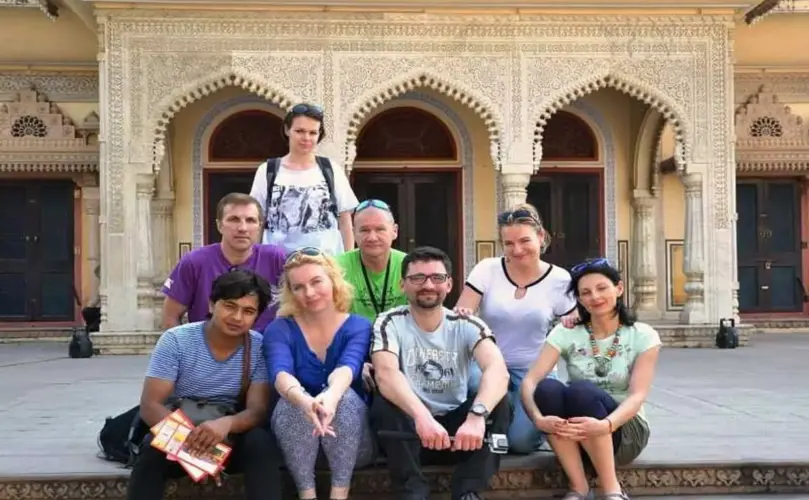
Margaret ran the travel committee of a church in Leeds, and her email to us arrived on a wet Tuesday morning. Twenty-three people, eleven days, Delhi to Agra to Jaipur and on to Amritsar, with three members using walking sticks and one wheelchair. She had already received two quotes from other companies. One offered four Innova Crysta cars, the other a 45-seater Volvo coach. Neither felt right to her, and she could not work out why one was nearly double the price of the other. We sent back a 27-seater AC coach with a separate luggage van, and her reply was one line: "That finally makes sense."
That small story sits at the heart of group transportation cost in India. The price is not only about the daily rate of a vehicle. It depends on how many seats you actually fill, how much luggage travels with you, how many drivers the route needs, where the vehicle can legally park, and which state borders you cross. Pick a vehicle that is too big and you pay for empty seats and parking headaches. Pick one that is too small and your group spends ten days with suitcases on their knees. This guide works through the real rates, the per-person maths and the rules that catch first-time group organisers out.
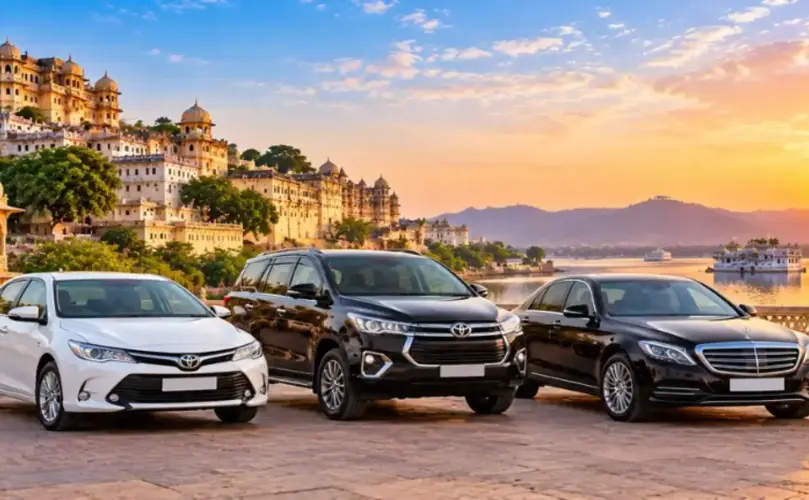
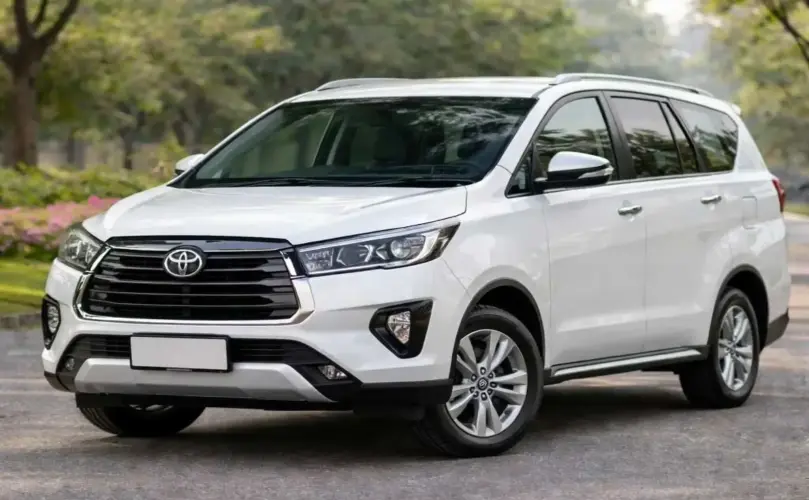
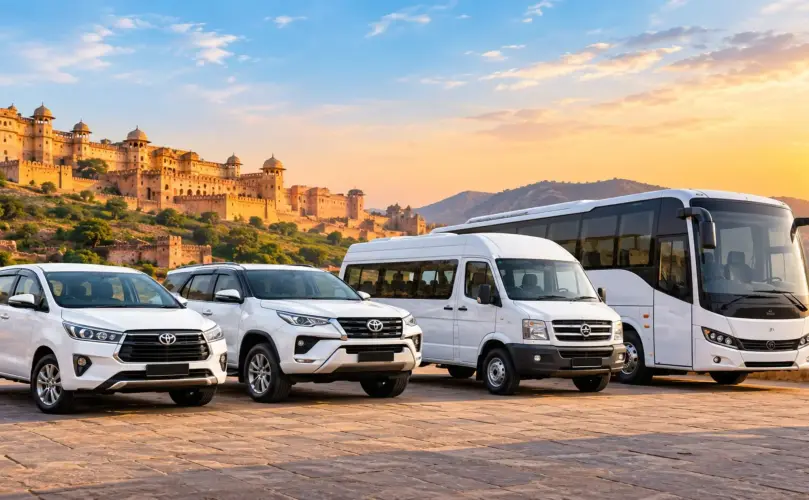
The most common question we get from groups of seven to nine people is whether to book two cars or one van. Two Innova Crysta with driver units cost roughly INR 5,500-6,500 each per day on an outstation trip with a 250 km daily minimum, so the pair comes to INR 11,000-13,000 a day before driver night allowances, which are also doubled. A single 12-seater Tempo Traveller hire costs about INR 8,000-10,000 per day with the same minimum, and only one driver needs a room and allowance at night. On price alone the van wins by around INR 3,000 a day. Two cars do have advantages. They are quicker on the Yamuna Expressway, easier to park in Jaipur's old city, and they let a group split up for an afternoon, with the shoppers going to Johari Market while the photographers head to Nahargarh Fort. Families with grandparents often prefer the van because everyone travels together and the guide can speak to the whole group at once.
For ten to twelve people, the Tempo Traveller is nearly always the answer. Book the 12-seater rather than the 9-seater, because the extra row gives you somewhere to put handbags and camera bags. Groups of thirteen to seventeen move into the minibus rental category: a Force Urbania 13 or 17-seater at INR 11,000-14,000 per day, or an 18-seater AC coach billed at INR 45-55 per km. The Urbania is newer, quieter and has proper pushback seats, but its luggage space is limited, so a group of sixteen with full-size suitcases may need the coach anyway.
From eighteen upwards you are in coach territory. A 27-seater AC coach at INR 60-70 per km suits groups of eighteen to twenty-two with luggage. A 35-seater at INR 75-85 per km fits twenty-five to thirty people comfortably. The 45-seater Volvo, at INR 110-140 per km with a 300-350 km daily minimum, is right for thirty-two to forty guests. Notice the pattern. We never fill a coach to its seat count. A 27-seater with twenty-seven adults and twenty-seven large bags is a miserable vehicle, because the rear seats end up stacked with luggage and the aisle becomes an obstacle course.
A useful rule is to take your headcount, add your guide and tour manager, then add twenty per cent for comfort and hand luggage. That number tells you the seat count to book. Margaret's group of twenty-three plus a guide came to twenty-four, plus twenty per cent made twenty-nine, which pointed towards a 35-seater. We chose the 27-seater with a luggage van instead, because the van cost less than the step up to the bigger coach and kept every seat free for people. The walking-stick members had the front two rows, and the wheelchair travelled folded in the van, never squeezed into the aisle.
Book Private Group Transportation Across India
Make group travel easier with private transportation tailored to your itinerary. From spacious SUVs and comfortable vans to larger group vehicles, find a suitable option for sightseeing, airport transfers and multi-city journeys across India.
Daily rates look frightening until you divide them by the number of people. Take a seven-day Golden Triangle route: Delhi sightseeing, a drive to Agra, a day at the Taj Mahal and Agra Fort, Fatehpur Sikri on the way to Jaipur, two days in Jaipur, and a drive back to Delhi or the airport. The billed distance usually lands at around 1,750 km for cars and vans once the daily minimum applies, and around 2,100 km for coaches with their higher minimum.
For a group of eight in a 12-seater Tempo Traveller at INR 9,000 per day, seven days comes to INR 63,000. Add tolls of around INR 6,000, the Rajasthan state permit for a Delhi-registered van at roughly INR 3,500, parking at INR 2,000 over the week, and driver night allowance at INR 700 for six nights, which is INR 4,200. That totals INR 78,700, and GST on transport at 5% lifts it to about INR 82,600. Per person that is INR 10,300, or about USD 121 for the whole week. The same group in two Innova Crystas would pay closer to INR 108,000 all in, or about USD 159 a head.
A group of fifteen in a Force Urbania at INR 13,000 per day pays INR 91,000 for seven days. Tolls for a larger vehicle run about INR 9,500, the state permit about INR 6,000, parking INR 3,000 and allowance INR 5,400. With GST the total is close to INR 120,000, or USD 1,410. Divided by fifteen it is INR 8,000, about USD 94 each.
Coaches change the maths because they are billed per km. A 27-seater at INR 65 per km over 2,100 km is INR 136,500. A 35-seater at INR 80 is INR 168,000. A 45-seater Volvo at INR 125 is INR 262,500. On top come tolls of INR 18,000-30,000 for the week, interstate permits and entry taxes of INR 15,000-35,000, coach parking, and two-crew allowances of INR 1,400-2,000 a night. For twenty-two people in the 27-seater, the all-in cost with GST is around INR 205,000, or INR 9,300 (USD 110) per person. For thirty in the 35-seater, roughly INR 245,000, or INR 8,200 (USD 96) each. For forty in the Volvo, about INR 365,000, or INR 9,100 (USD 107) each, because you are paying for air suspension and a premium chassis.
The cheapest seat in India is a well-filled mid-size coach. The most expensive is a half-empty Volvo. Ask any operator to show you the cost per person, not just the daily figure, and to list what is excluded. Monument tickets, guides, meals and tips for the crew are never part of a private vehicle hire rate, and at Payless Tours India we show those separately so a committee treasurer can see exactly where each rupee goes.
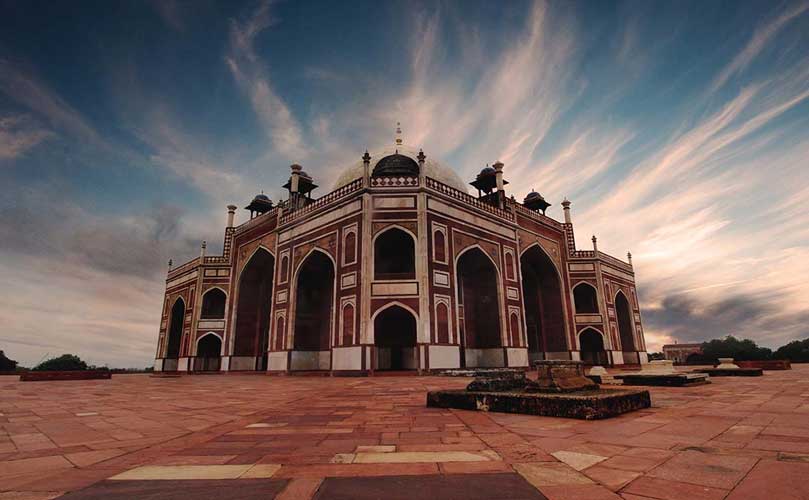
Different groups break vehicles in different ways, and the quote should reflect that. School and university groups from the UK or US usually travel with thirty to forty students and four to six staff. They want one coach so teachers can count heads at every stop, and they want a fixed daily schedule because a coach full of teenagers cannot wait an hour while a driver hunts for fuel. For these groups we put a 45-seater on the job with two crew, a first-aid kit, and a rule that the coach leaves the hotel at a fixed time each morning. Universities on study trips to Delhi often add local days at INR 30,000-40,000 for the Volvo, visiting Humayun's Tomb (foreigners INR 600), Qutub Minar (INR 600) and the Red Fort (INR 550, closed Mondays), with a lecture stop at a college in between.
Wedding guest transport is a different animal. A destination wedding in Udaipur or Jaipur may have 120 guests arriving on fifteen different flights over two days. Here a single big coach is useless. The smart setup is a fleet: two or three 12-seater Tempo Travellers running airport shuttles, a few Innova Crystas for elderly relatives and the couple's parents, and one or two 35-seater coaches for the big movements, such as the run from the hotel to the wedding venue and back after midnight. That midnight return attracts a night charge of INR 300-500 per vehicle, and every driver needs an allowance. Budget INR 6,000-9,000 per guest for three days of wedding movements at the higher end of the market, more if the venue is a palace an hour outside town.
Corporate offsite transport tends to be short and intense: an airport pickup, two days at a resort near Gurugram or in the Aravalli hills, a gala dinner, and an airport drop. Companies care about branding, punctuality and clean vehicles more than the last rupee. They often ask for a 45-seater Volvo for the group plus a Mercedes E-Class at INR 11,000-14,000 a day for the senior leadership. The coach on a two-day local package costs INR 65,000-80,000 plus GST, parking and the crew allowance. A dedicated coordinator riding with the coach is a sensible extra at INR 3,000-4,000 a day.
Church and pilgrim groups, like Margaret's, travel slowly and with purpose. Christian groups often add Goa or Kerala, while Sikh heritage groups go to Amritsar for the Golden Temple, and Buddhist groups head to Bodh Gaya, Sarnath and Kushinagar. These routes cross many state borders, which means more permit fees, and pilgrim days often start before sunrise. A Delhi to Amritsar leg is about 450 km and eight to nine hours, so it is billed at the actual distance, not the daily minimum. Pilgrim groups also stop more, for prayer, rest and toilets, so we build in a slower average speed of 45-50 km per hour on highway days. The coach is not just transport for them; it is where the group prays together in the morning, so a working microphone and a front seat for the group leader matter more than wifi.
Explore India with Private Group Transportation
From Golden Triangle tours to extended Rajasthan and North India itineraries, enjoy the flexibility of private group travel. Arrange a vehicle around your route, planned stops and group requirements for a more convenient journey.
The luggage van for groups is the single most useful extra that first-time organisers never think about. A 27 or 35-seater coach has a boot under the floor, but it fills quickly with forty-kilo combinations of suitcase, carry-on and shopping. Indian coaches built on truck chassis often have smaller boots than European coaches. A Tata Winger or Maruti Eeco van following the coach costs about INR 3,500-5,000 per day outstation, with its own driver allowance. It means every seat in the coach is for a person, the bags reach the hotel before the group, and porters at the hotel can move luggage to rooms while the group is still at dinner. For a group of twenty-five, the van adds roughly INR 1,500 per person over a week, and almost every group says it was worth it.
The two-driver coach system is standard on any large coach doing long days. The second crew member is not always a full driver; sometimes he is a helper who handles luggage, checks tyres, cleans the coach at night and guides the main driver when reversing into tight spots. On long routes, such as Jaipur to Jodhpur via Ajmer (about 340 km) or Delhi to Amritsar, a genuine second driver means the first never drives tired. Expect INR 700-1,000 per night allowance for each crew member, and ask the operator how the crew sleep. Some operators let the crew sleep in the coach, which is unsafe and leaves them exhausted. We insist on a proper driver room, which most hotels provide for INR 300-800 or include free.
Then come the line items that appear on the final bill. Tolls for a coach run two to three times those of a car: the Delhi to Agra stretch of the Yamuna Expressway costs a 45-seater around INR 2,200-2,600 one way. Parking at monuments, hotels and markets ranges from INR 100 for a car to INR 500-1,000 for a coach. Interstate coach permits are the big one, covered in the next section. Night driving between 10 pm and 6 am attracts INR 300-500 per vehicle for cars and more for coaches, and many coach operators simply refuse to drive certain highways at night. Waiting charges kick in if the group keeps the vehicle beyond the agreed hours on a local day, typically INR 400-600 per hour for a van and INR 1,500-2,000 per hour for a large coach.
Ask for all of these to be shown as separate lines or included in a fixed price. A quote that says "INR 70 per km" and nothing else is a quote that will grow. A good operator will tell you the expected km, the minimum per day, the estimated tolls and permits, and the GST, so that the committee or the finance team can approve one figure.
Agra is the place where coach logistics become most visible. Petrol and diesel vehicles cannot drive right up to the Taj Mahal, because the area around the monument is a protected zone. Coaches stop at the Shilpgram coach parking near the East Gate, where there is a large parking area, toilets and handicraft shops. From Shilpgram, battery-operated buses and electric golf carts run to the East Gate, about one kilometre, for a small fee of around INR 20-50 per person. Many groups simply walk, which takes fifteen minutes. Cars face the same rule and use parking near the East or West Gate. The Taj Mahal opens 30 minutes before sunrise and is closed on Fridays. Foreign visitors pay INR 1,100 plus INR 200 for the main mausoleum, so a group of thirty pays about INR 39,000 in tickets alone. Agra Fort (INR 650 for foreigners) has a coach park close to the entrance, but it gets crowded by 10 am.
Jaipur brings its own challenges. Amber Fort (foreigners INR 500, 8:00 am to 5:30 pm) has a coach park below the fort, and from there groups take jeeps up the ramp or walk. The jeeps cost around INR 400-600 per jeep for four to five people. Large coaches cannot enter the narrow streets of the walled city around Hawa Mahal and the City Palace (foreigners about INR 700), so drivers drop the group at the main gates and the group walks or takes auto-rickshaws to the inner lanes. In Delhi, coaches are not allowed in parts of Old Delhi near Chandni Chowk, so groups switch to cycle-rickshaws from the Red Fort parking area.
Permits are the other piece. A commercial vehicle registered in Delhi needs a Rajasthan state permit or an all-India tourist permit to carry passengers into Rajasthan, Punjab or Uttar Pradesh. For cars this is about INR 1,000-2,000 per entry, but for coaches the state road tax at the border can reach INR 10,000-25,000 per entry depending on seat count and days, and it is charged again at each state. A Golden Triangle route crosses from Delhi into Uttar Pradesh for Agra and then into Rajasthan for Jaipur, so a coach may pay two separate state taxes. Good operators hold all-India permits for their coaches, which removes some of the border charges, but never all of them.
When you compare quotes, check whether permits and border taxes are included. A coach quote that looks INR 30,000 cheaper may simply have left them out, and the driver will ask you for cash at the Rajasthan border at seven in the morning. Ask the operator for the registration number of the vehicle and the permit type, and you will know exactly what you are getting.
Everything foreign travellers usually ask before booking a Rajasthan tour. Still unsure? Just send us a message.
Ask a questionA 12-seater Tempo Traveller costs about INR 8,000-10,000 (USD 94-118) per day on an outstation trip, with a 250 km daily minimum and extra km at INR 30-36. Tolls, parking, state permits, driver night allowance of INR 700 and 5% GST are usually extra.
One 12-seater van is usually cheaper by INR 2,500-3,500 per day, because you pay one driver allowance and one set of tolls. Two Innova Crysta cars cost INR 11,000-13,000 a day combined but give you flexibility to split up.
For most group sizes, all-in private transport works out at INR 8,000-10,500 (USD 94-124) per person for a seven-day Golden Triangle route. Well-filled 27 and 35-seater coaches give the lowest per-head cost.
Book a 27-seater for no more than twenty-two people if they carry full-size suitcases. With a separate luggage van you can seat twenty-four to twenty-five people in comfort.
No. Coaches park at Shilpgram near the East Gate, and battery buses or electric carts carry visitors about one kilometre to the gate for INR 20-50. Walking takes around fifteen minutes.
Long highway days of 300-450 km are tiring, and the second crew member handles luggage, reversing and cleaning. Each crew member receives INR 700-1,000 per night allowance plus a room.
State border taxes for a large coach can be INR 10,000-25,000 per state entry, depending on seats and days. A Golden Triangle coach may pay for Uttar Pradesh and Rajasthan separately unless an all-India permit covers part of it.
For groups of twenty or more on a multi-city route, a luggage van at INR 3,500-5,000 per day is strongly advised. It frees every coach seat for people and adds only about INR 1,500 per person per week.
The rate normally covers the vehicle, fuel, the driver and the daily km minimum. Tolls, parking, state permits, night allowance, night charges, waiting charges and 5% GST are added separately unless the quote is all-inclusive.
Book coaches three to four months ahead for October to March, and six months ahead for weddings or school trips over Christmas and Easter. Good 45-seater Volvos run out first in peak season.
Share your details and our travel experts will write back with a tailored itinerary and quote - usually within 24 hours, with no obligation.
Share your query and our team will write back in the shortest possible time with every detail you need.
Tell us when and how you like to travel. We'll send a tailored itinerary within 24 hours - no obligation.
Plan my trip free