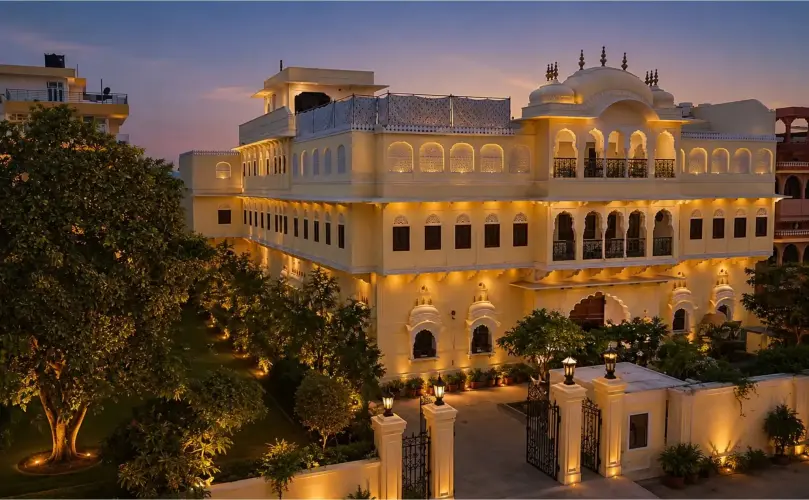
Claire and David from Manchester arrived in Jaipur late on a January afternoon after the drive from Agra. Their driver, Rakesh, turned off a busy road near the old city wall, through an arched gate, and stopped in a quiet courtyard where a fountain was running and a parrot sat on a carved stone balcony. A man in a white tunic brought two cups of hot ginger tea and a garland of marigolds. Their room had a painted ceiling, green shutters and walls almost a metre thick. The bathroom was smaller than at home and there was no lift, but David said it was the first hotel on their trip that felt like it belonged to the city around it.
That is the appeal of a haveli. Jaipur has dozens of old family mansions that now take paying guests, and they range from grand properties with pools and fine dining to simple guesthouses run by the same family for generations. This guide explains what a haveli stay is and what to expect, gives prices for the best-known properties on the higher side of the market, shows where each one sits in relation to the walled city and Amber Fort, and covers the main Jaipur sights with tickets and timings, plus the booking details that save money.
A haveli is a traditional mansion built around one or more open courtyards. In Rajasthan, wealthy merchant families, court officials and minor nobles built them inside and just outside the city walls. The design is practical for the desert climate. Thick stone or lime-plaster walls keep the rooms cool in summer and warm in winter. The inner courtyard brings in light and air while keeping out the street noise and dust. Upper floors have small balconies and screened windows so the family could watch the street without being seen. Many have a separate front courtyard for receiving guests and an inner one for the family.
Over the past few decades, many of these families found the buildings too large and costly to maintain, and turned them into small hotels. A heritage haveli hotel in Jaipur is usually still owned and often run by the same family. The owner may greet you at breakfast, tell you about a great-grandfather who served at the court of the Maharaja, and recommend a tailor in the old city. That personal touch is the main difference from a five-star chain hotel. The service is warm but sometimes slower, and the rooms are full of family portraits, old furniture and painted plasterwork rather than matching modern fittings.
The Indian government grades some of these properties under its Heritage Hotel scheme, with categories such as Heritage, Heritage Classic and Heritage Grand. Others are simply described as heritage or boutique. The label matters less than the building itself, the location and recent guest reviews. In Jaipur, the word is used loosely; some places called havelis are former garden palaces, some are hunting lodges and some are modern buildings with old-style decoration. That is not necessarily a problem, but it helps to know what you are booking.
A haveli stay suits travellers who want character and atmosphere more than a big pool and a gym. Couples, solo travellers and small families usually love it. People with mobility problems or very large suitcases should choose carefully, because many of these buildings have steep stairs and narrow corridors. Larger groups of 15 or more travelling by coach may find that the smaller properties cannot take them all, or that the lane outside is too narrow for a 35-seater coach to stop.
Most visitors stay two or three nights in Jaipur, often arriving from Delhi, which is about 270 km and 4.5 to 5.5 hours away by road on NH 48 and the Delhi-Mumbai Expressway section, or from Agra, about 240 km and 4 to 5 hours away. A night or two in a haveli fits well between a modern hotel in Delhi and a lake view hotel in Udaipur, giving a different feel at each stop on the route. If you are booking a Golden Triangle tour, ask your operator to price one haveli option for Jaipur next to the standard five-star choice; the difference in cost is often smaller than people expect, and the difference in experience is large.
Experience Jaipur’s Royal Heritage in a Traditional Haveli
Step into Jaipur’s royal charm with a stay in a beautiful heritage haveli featuring traditional courtyards, intricate architecture, and personalised hospitality. Let us help you plan a memorable Jaipur experience with carefully selected accommodation and private sightseeing.
Samode Haveli is the grand choice. It is a 200-year-old mansion of the Samode family, the same family that owns Samode Palace outside the city, and it sits inside the walled city near Gangapole, in the north-east corner. It has a large garden courtyard, a swimming pool, a painted dining room and suites decorated with mirror work. Rooms cost about INR 18,000-35,000 (USD 210-410) a night, with the top suites at the higher end. Add 18% GST on all rooms above INR 7,500.
Alsisar Haveli is on Sansar Chandra Road, just outside the western wall of the old city, near the Chandpole gate. It was built by the Alsisar family of Shekhawati and has a pool, a long dining hall and quiet courtyards. Rooms run INR 9,000-16,000 (USD 105-190). Shahpura House, in the Bani Park area about 2.5 km north-west of the walled city, belongs to the Shahpura family and is known for its rooftop restaurant, mirror work dining room and friendly service. Rooms are similar in price, at INR 9,000-16,000. Both are good mid-to-upper choices with easy car access and parking.
Narain Niwas Palace on Kanota Bagh, Narain Singh Road, is about 3 km south of the walled city, close to Rambagh Palace. It is a garden palace rather than a classic courtyard house, built by the Kanota family, with large lawns, peacocks, a pool and rooms full of old family furniture. Rooms cost INR 10,000-18,000 (USD 120-210). Hotel Diggi Palace, on Shivaji Marg near Sawai Ram Singh Road, about 1.5 km south of the old city, is the home of the Diggi family and the original venue of the Jaipur Literature Festival. It has a big garden, a relaxed atmosphere and rooms from INR 7,000-13,000.
Dera Mandawa, on Sawai Jai Singh Highway in Bani Park, is a small family home with around 10 rooms and a lovely garden courtyard. It costs about INR 6,000-11,000 (USD 70-130), and the owners are known for home-cooked Rajasthani food. Pearl Palace Heritage, also in the Bani Park and Hathroi Fort area, is a smaller, newer property built in heritage style with hand-painted rooms, each themed on a different craft or region. Rooms run INR 5,000-9,000 (USD 60-105), making it the best-value choice on this list. Rooms up to INR 7,500 carry 5% GST, and above that 18%. 28 Kothi, a modern boutique house, costs INR 12,000-20,000.
When you compare prices, check what each rate includes. Most haveli rates include breakfast, which is usually cooked to order with fresh fruit, eggs, Indian dishes and toast. Dinner at the hotel restaurant costs INR 1,500-3,500 per person, and some places serve a Rajasthani set meal in the courtyard with folk music. Airport transfers from Jaipur Airport, about 12 km south of the old city, cost INR 1,200-1,800 in a sedan and INR 2,000-2,800 in an Innova Crysta, less than a hotel car. Driver accommodation varies; some havelis provide a room, others ask the driver to stay at a nearby lodge at INR 400-700 a night.
A haveli is an old house, and it behaves like one. The first thing to expect is stairs. Many properties have no lift at all, or a small lift that does not reach every floor. Rooms on the upper levels, which usually have the best balconies and views, may be 40 to 70 steps up narrow stone staircases with uneven treads. Staff will carry your luggage, but you will climb several times a day. If anyone in your party has knee or hip problems, ask for a ground-floor or courtyard-level room when you book, and confirm it in writing.
The second thing is the walls. Thick walls make the rooms very quiet, cool in April and cosy in January, but they also block mobile signal and Wi-Fi in some rooms. Windows are often small, with coloured glass or wooden shutters, so rooms can feel dark during the day. That is part of the charm for some travellers and a disappointment for others. If you want plenty of natural light, ask for a room facing the courtyard or garden with a balcony, rather than an inner room.
Haveli room sizes vary a great deal, even within one property. Because the rooms were not built as hotel rooms, two rooms in the same category may be very different in shape. One may have a huge carved bed and a sitting alcove; the next may be narrow with a low doorway. Bathrooms were usually added later, so they are often smaller than in modern hotels, with a shower rather than a bath, and occasionally a step down or up into the bathroom. Water pressure can be lower on the top floors, and hot water may come from an electric heater that needs 10 to 15 minutes to warm up.
Expect simple, personal service rather than a large staff. A small haveli may have one person on the front desk at night and a family member who manages everything. Room service may stop at 10:00 or 11:00 pm. Card payments are accepted almost everywhere, but carry some cash for small tips: INR 100-200 for the porter, INR 500-1,000 for the staff box at the end of a two-night stay. Air conditioning is standard in the better properties, though some rooms in older parts have only a ceiling fan and a heater, which is fine from November to February but uncomfortable in May.
The good side is real. Mornings in a haveli courtyard, with pigeons on the parapets and the sound of temple bells from the old city, are among the nicest moments of a Rajasthan trip. The owners can arrange a cooking lesson, a puppet show, or a walk through the textile workshops of the old city with a family friend. Many travellers say that the heritage stay in Jaipur was the night they remember most, precisely because it was not polished. The trick is to choose with open eyes, book the right room and set your expectations for an old family home rather than a modern tower hotel.
Discover Jaipur with Heritage Charm and Private Comfort
Combine an authentic haveli stay with private chauffeur-driven sightseeing and a flexible itinerary. Explore Amber Fort, City Palace, and Jaipur’s colourful old-city markets while enjoying a more comfortable and personalised journey.
Location shapes your stay more than most people expect. Jaipur's old walled city, often called the Pink City, is a rough rectangle about 3 km by 2 km, with gates such as Chandpole on the west, Sanganeri Gate on the south and Gangapole in the north-east. Samode Haveli is the main upscale property inside the walls, which means you can walk to the markets of Johari and Bapu, though the lanes are busy and noisy. Alsisar Haveli sits just outside Chandpole, about 1 km from the City Palace. Shahpura House, Dera Mandawa and Pearl Palace Heritage are in Bani Park, a quieter residential area 2 to 3 km north-west, 10 to 15 minutes by car. Narain Niwas and Diggi Palace are south of the walls, 1.5 to 3 km away.
Amber Fort is the big sight, 11 km north of the old city on the Delhi road. From Bani Park or Alsisar, the drive takes 25 to 35 minutes; from Narain Niwas, 35 to 45 minutes. The fort is open from 8:00 am to 5:30 pm, and the Amber Fort ticket costs INR 500 for foreigners. Go early, ideally at opening time, before the tour coaches arrive and the heat rises. A jeep up the hill costs about INR 500-600 per jeep, or you can walk up the ramp in 15 to 20 minutes. Allow two to three hours with a guide.
The City Palace Jaipur sits in the centre of the walled city and costs about INR 700 for foreigners for the standard museum entry, with higher tickets for the private royal apartments. It opens from 9:30 am to 5:00 pm, with a separate night entry on some evenings. Next door is Jantar Mantar, the stone astronomical observatory with giant sundials, open 9:00 am to 4:30 pm, with a foreigner ticket of about INR 200. Hawa Mahal, the five-storey pink facade with 953 small windows, is a short walk away. It opens from 9:00 am to 4:30 pm, and the ticket is about INR 200 for foreigners. Photograph it early from the rooftop cafés opposite.
A composite ticket for foreigners, valid for two days, costs about INR 1,000 and covers Amber Fort, Hawa Mahal, Jantar Mantar, Albert Hall Museum, Nahargarh Fort and a few other monuments, though not the City Palace. It is good value if you see three or more of these. A Jaipur sightseeing car with driver for a full day costs INR 3,500-4,200 in a sedan and INR 5,000-6,500 in an Innova Crysta, with parking at Amber Fort about INR 200-300 and in the old city INR 100-200. A licensed English-speaking guide costs INR 3,500-5,500 for a full day. Booking through your tour operator is usually cheaper than through the hotel.
If you have a third day, add Nahargarh Fort for the sunset view over the city, open until about 5:30 pm with an evening restaurant, or a half-day trip to Samode, 42 km away, to see the palace's painted hall.
The peak season in Jaipur runs from October to March, when days are 20-28°C and nights cool. Prices are highest from mid-December to early January and during the Jaipur Literature Festival in late January, when Hotel Diggi Palace and the nearby havelis fill months ahead. For those dates, book a haveli in Jaipur four to six months in advance. For the rest of the winter, six to ten weeks is usually enough. Summer, from April to June, is very hot at 40-45°C, and rates fall by 30-40%. The monsoon, from July to September, brings green gardens and lower prices, but some outdoor dining closes when it rains.
Because rooms vary so much, the room category name is more important here than in a chain hotel. Ask for a description of the exact room: the floor, the number of steps, the size of the bathroom, whether it has a bath or shower, whether it faces the courtyard or the street, and whether it has a balcony. Ask for photos from inside the room. If you travel in winter, ask whether the room has heating, because thick walls can feel cold at night in January when temperatures drop to 6-8°C. In summer, confirm air conditioning.
Check what is included before paying. Most haveli room prices in Jaipur include breakfast, but confirm whether GST is in the quoted rate or added at checkout. Rooms up to INR 7,500 carry 5% GST and rooms above that 18%. Check the cancellation rule; small properties often require a deposit of 30-50% and may keep it for late cancellations. Ask whether the haveli has parking for your car and a room for your driver, or whether the driver stays nearby. The driver's night allowance of INR 400-600 is separate and is normally part of your car rental quote. Car rental also carries 5% GST, plus tolls of about INR 400-600 on the Delhi-Jaipur road.
For a typical three-night stay for two in a mid-range haveli at INR 12,000 a night with breakfast, add 18% GST and the bill comes to about INR 42,500 (USD 500). Add a car with driver for sightseeing, guide fees and monument tickets, and a full Jaipur stop costs a couple roughly INR 65,000-85,000 (USD 765-1,000). Choosing Pearl Palace Heritage or Dera Mandawa brings the room cost down by more than half, while Samode Haveli roughly doubles it.
At Payless Tours India we usually suggest one night in a haveli even for travellers who want modern hotels elsewhere, and we send room photos and the exact category before taking payment. Whoever you book with, ask for those details in writing. A clear email about stairs, bathroom, view and taxes means the courtyard, the painted ceiling and the cup of ginger tea are the only surprises waiting for you when the car pulls through the gate.
Everything foreign travellers usually ask before booking a Rajasthan tour. Still unsure? Just send us a message.
Ask a questionA haveli is an old courtyard mansion built by a wealthy family, now converted into a small hotel. In Jaipur, many are still run by the original family. Expect thick walls, painted rooms, courtyards and personal service rather than modern chain-hotel fittings.
Simple heritage guesthouses start around INR 5,000-9,000 (USD 60-105) a night, such as Pearl Palace Heritage. Mid-range havelis like Alsisar Haveli and Shahpura House cost INR 9,000-16,000. Samode Haveli runs INR 18,000-35,000, plus 18% GST.
Many do not, or the lift does not reach every floor. Upper rooms may be 40 to 70 steps up narrow staircases. Ask for a ground-floor or courtyard room if anyone has mobility problems.
Samode Haveli is inside the walled city, about 2 km from the City Palace. Alsisar Haveli is just outside Chandpole gate, about 1 km away. Both are 5 to 10 minutes by car from Hawa Mahal.
Amber Fort is 11 km north of the old city. From Bani Park, Alsisar Haveli or Samode Haveli the drive takes 25 to 35 minutes. From Narain Niwas or Diggi Palace, south of the walls, allow 35 to 45 minutes.
Amber Fort is open from 8:00 am to 5:30 pm, and the foreigner ticket is INR 500. A jeep up the hill costs about INR 500-600 per jeep. Arrive at opening time to avoid crowds and heat.
Most haveli rates in Jaipur include breakfast, usually cooked to order with Indian and Western dishes. Confirm this when booking. Dinner costs INR 1,500-3,500 per person extra.
Often yes, because bathrooms were added to old rooms later. Expect a shower rather than a bath in many rooms, and sometimes a step into the bathroom. Ask for photos if bathroom size matters to you.
The festival is held in late January, with Diggi Palace as the original venue. Book four to six months ahead for those dates. Rates are at their highest and small properties fill quickly.
The two-day composite ticket for foreigners costs about INR 1,000 and covers Amber Fort, Hawa Mahal, Jantar Mantar, Albert Hall, Nahargarh and others. It pays off if you see three or more of these. It does not include the City Palace, which costs about INR 700 separately.
Share your details and our travel experts will write back with a tailored itinerary and quote - usually within 24 hours, with no obligation.
Share your query and our team will write back in the shortest possible time with every detail you need.
Tell us when and how you like to travel. We'll send a tailored itinerary within 24 hours - no obligation.
Plan my trip free