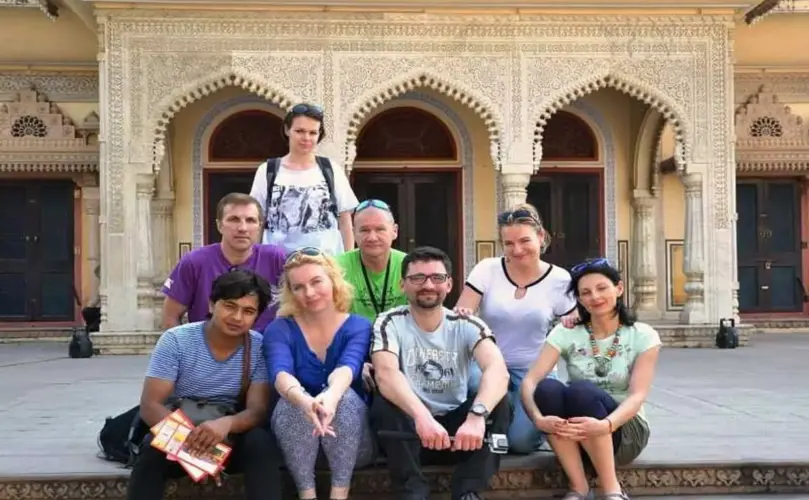
The O'Connor family reunion had been talked about for years before anyone booked it. Fourteen people flew in from Dublin, Boston and Perth, landing at Delhi's Terminal 3 within six hours of each other. Their driver, Sanjay, waited at Gate 6 with a placard, and by the time the last cousin walked out, the 17-seater Force Urbania was parked in the pickup lane with cold water bottles on every seat and fourteen suitcases already strapped and covered on the roof rack. The eldest aunt, aged seventy-eight, took the front seat next to Sanjay and declared it her seat for the next ten days. Nobody argued.
That trip is a good picture of why the minibus is the most popular vehicle we hire to small groups. It sits between the car and the coach, big enough to keep a family or club together, small enough to reach a village stepwell, a desert camp or a narrow lane in Udaipur. But the category is wide. A 9-seater Tempo Traveller and a 16-seater Volkswagen Crafter are very different vehicles, with very different prices and comfort levels. This guide sets out the real private minibus rental cost in India, what each model is like on a long Rajasthan highway, how luggage travels, and what a ten-day Rajasthan loop actually costs.
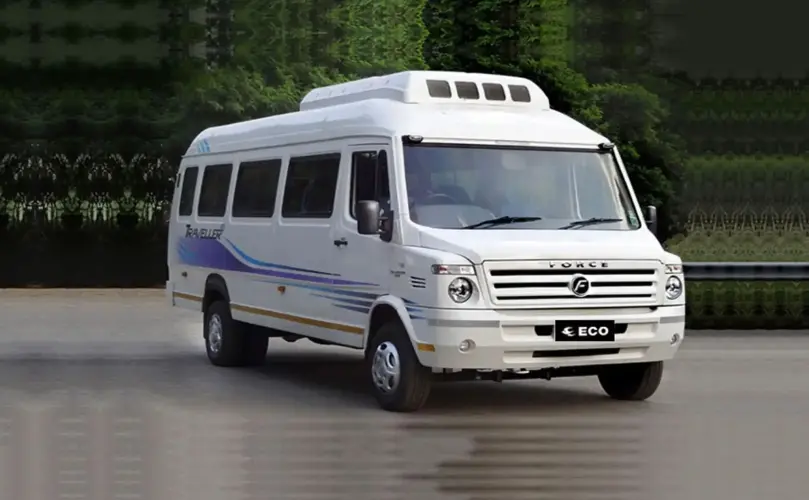
The Tempo Traveller made by Force Motors is the workhorse of Indian group travel. It comes in 9, 12 and 16-seater layouts, plus a 26-seater that is really a small coach. The 9-seater has four rows with a wide aisle and is the most comfortable of the range, ideal for six or seven adults with luggage. The 12-seater is the most hired version, and fits nine or ten adults in comfort. The 16-seater squeezes in seats by narrowing the aisle, and works well for twelve or thirteen people on short days, but it is tight for long highway legs. Older Tempo Travellers have a high floor, a sliding or folding side door and an air-conditioning unit fed through roof ducts. Newer luxury versions, often sold as "Maharaja" fit-outs, add leather captain seats, LED lights, curtains and a small television.
The Force Urbania is the newer model, built on a monocoque body with a lower floor, better suspension and a much quieter cabin. It comes in 10, 13 and 17-seater layouts. The ride on concrete expressways is noticeably smoother than a Tempo Traveller, and the air conditioning cools the rear rows properly, which was always a weak point in the older van. Elderly travellers find it easier to climb into, because the step height is lower. The trade-off is luggage space. Its rear boot is small, and many Urbanias are not fitted with a roof carrier, so a group of fifteen with large bags may need a luggage van or a bigger vehicle.
At the top of the range sit imported-style vans such as the Volkswagen Crafter and Toyota Commuter type vehicles. Payless Tours India runs Crafters, which offer European build quality, high roofs that let most adults stand up inside, individual reclining seats with armrests, and a large rear boot. They are expensive, with fewer available in the market, and are mostly booked by corporate clients, luxury small-group tours and families who want something closer to a European touring van. A Toyota Commuter style van is similar in feel, with a firmer ride and good reliability, though they are rarer in north India.
To match people to vehicles, count adults and luggage, not just seats. A group of eight with medium bags is perfect in a 12-seater Tempo Traveller or a 10-seater Urbania. A group of twelve fits a 16-seater Tempo Traveller only if bags go on the roof, or a 17-seater Urbania with a small luggage van. Fourteen to sixteen people with full luggage are best in a Crafter or a 17-seater Urbania with a luggage support vehicle. Above sixteen, look at an 18 or 27-seater coach instead. Our rule is simple: leave at least two empty seats in any minibus for handbags, cameras and the shopping that every group seems to collect by the third day.
Get a Personalised Minibus Rental Quote
Want to plan your group transport budget in advance? Tell us your route, group size and trip duration to request a tailored minibus rental quote. Clarify the services included and any additional charges before confirming your booking.
Comfort in a minibus comes down to three things: the seats, the suspension and where the luggage goes. Pushback seats in a Tempo Traveller recline by about 20 to 30 degrees, which is enough to nap on a four-hour drive from Jaipur to Pushkar or Ranthambore. Ask for the 2+1 layout, which means two seats on one side of the aisle and one on the other. A 2+1 12-seater feels spacious. A 2+2 16-seater with the same body length is cramped, with narrow seats and little legroom. Seat belts are fitted in most vehicles now, but check the rear rows, because some older vans only have belts at the front. Our drivers are told to ask every passenger to belt up on expressways, where cars cruise at 100 km per hour.
The luggage question is where groups get surprised. Older Tempo Travellers carry bags on a roof carrier, with a metal frame, a ladder at the rear and a tarpaulin that is tied down with rope. It works well on dry highways and allows up to twelve or fourteen full-size suitcases, but bags must be lifted up and down at every hotel, which takes the driver and a helper ten to fifteen minutes. In the monsoon months of July to September, a poorly covered roof load can arrive wet. Some hotels in the walled cities have low arches at their entrances, and the van with a full roof rack cannot get in, so the driver unloads outside.
The alternative is a minibus with rear boot space. The Urbania and Crafter keep luggage inside, behind the last row, safe from dust, rain and theft. The Crafter boot takes ten to twelve large bags. The Urbania 17-seater takes six to eight, which is why groups often fold one rear row down for luggage, losing three seats. Inside storage is cleaner, faster at hotels and better in the monsoon. Plenty of foreign groups also simply feel happier when their bags are in sight.
Suspension makes a bigger difference than people expect. Rajasthan's national highways, such as NH 48 between Delhi and Jaipur and NH 62 between Jodhpur and Jaisalmer, are mostly good four-lane roads. The trouble starts on state roads, such as the stretch from Ranakpur to Kumbhalgarh or the last 40 km into Bundi, where speed breakers appear without warning and the surface can be broken. A Tempo Traveller with leaf springs bounces on these, and passengers in the last row feel every bump. The Urbania and Crafter absorb them far better. For a group with elderly travellers or anyone with back trouble, the price difference is worth paying, and we always seat those travellers in the middle rows, which ride smoothest in any van.
Minibus prices in India are quoted in two ways: a daily rate with a minimum distance, or a straight per-km rate with a daily minimum. On outstation trips both arrive at roughly the same figure. A 9 or 12-seater Tempo Traveller rate per km runs about INR 30-36 on the higher side of the market, with a 250 km daily minimum, which gives a daily figure of INR 8,000-10,000 (USD 94-118). The 16-seater is about INR 34-40 per km, or INR 9,000-11,000 per day. Luxury Maharaja fit-outs add INR 1,500-3,000 a day. The Force Urbania hire price sits at INR 11,000-14,000 per day (USD 130-165) for the 13 and 17-seater, with extra km at INR 42-50. A Volkswagen Crafter runs INR 14,000-18,000 per day (USD 165-212), with extra km at INR 55-65.
Local use in a city is different. A Delhi local day of 8 hours and 80 km in a 12-seater Tempo Traveller costs about INR 5,500-7,000, and an Urbania INR 7,500-9,000. Extra hours are INR 400-600 each. Airport transfers are priced separately: a Tempo Traveller from Delhi airport to central Delhi or Aerocity runs INR 4,500-6,000, and from the airport to Agra INR 14,000-18,000, or to Jaipur INR 15,000-19,000, one way.
Then come the extras that every honest quote lists. Tolls for a minibus are higher than for a car: the Yamuna Expressway from Delhi to Agra costs a van about INR 1,200-1,500 one way, and the Delhi to Jaipur run on NH 48 another INR 1,000-1,400. Rajasthan state permit for a Delhi-registered van costs INR 3,000-5,000 per entry, and Uttar Pradesh charges its own fee when entering Agra. Parking at monuments and hotels runs INR 150-400 each time. Driver night allowance for a minibus driver is INR 600-800 per night. Night driving between 10 pm and 6 am attracts INR 400-600. And 5% GST is charged on the total transport bill.
Let us put that together for a single day. A 12-seater Tempo Traveller doing Jaipur to Jodhpur, about 340 km, bills 340 km at INR 33, which is INR 11,220. Add INR 600 in tolls, INR 700 driver allowance and INR 300 parking, for INR 12,820, plus GST of INR 641, so INR 13,461 in total. For ten people that is INR 1,346 each, about USD 16 for the day. In an Urbania at INR 46 per km, the same day comes to around INR 18,000, or USD 21 per head. A Crafter at INR 60 per km costs around INR 23,000, or USD 27 per head.
A newer vehicle with working air conditioning, clean seat covers and a driver who speaks good English is worth more than a cheaper van that breaks down outside Ajmer. Ask for the year of registration, a photograph of the actual vehicle, and the driver's name before you pay a deposit. A vehicle that is more than five or six years old on a long route is a risk, however polite the quote.
Book a Private Minibus for Your India Group Tour
Keep your group together and make travelling across India more convenient with a private minibus. Whether you're planning sightseeing, airport transfers or a multi-city tour, arrange group transportation around your itinerary and travel requirements.
A minibus changes the feel of a trip for a mid-size group. With two cars, conversations split and stories get told twice at dinner. In one van, the whole group hears the guide explain why the Hawa Mahal has 953 windows, everyone sees the camel cart on the road at the same moment, and the driver becomes part of the family by day three. That is why family reunion travel in India is one of the biggest uses of the Tempo Traveller and the Urbania.
For a reunion of ten to sixteen, the first job is to fix one seating rule. Older relatives sit in the middle rows, where the ride is smoothest. Children and teenagers take the back. The front seat next to the driver goes to whoever gets carsick, not the loudest uncle. These rules sound small, but on a ten-day route they decide whether the group arrives at Udaipur cheerful or arguing. A minibus also needs regular stops. We build in a break every two to two and a half hours at a clean highway restaurant with western toilets, such as the stops on NH 48 near Behror or on the Jaipur to Ajmer road. Grandparents and toddlers set the pace, and the driver knows it.
Small group tours in a minibus run by clubs, alumni associations, photography groups or special-interest travellers work the same way. A garden club from Surrey travelling with fourteen members wanted to see the step wells of Abhaneri, the Bundi palace murals and the gardens of Udaipur. A coach could not have reached Chand Baori at Abhaneri easily, because the last few kilometres are narrow village roads, but a 17-seater Urbania drove right up to the entrance. The same applies to the lanes around Bundi palace and the small road up to Kumbhalgarh Fort, where a 45-seater coach would struggle and a minibus fits.
A group minibus with driver also lets the group change the day without fuss. If the morning light at the Jal Mahal is perfect, the driver can pull over. If a member feels unwell, the driver can drop them at the hotel and return in thirty minutes. For groups with a guide, the guide sits in the front row with a microphone, which most newer vans have fitted. Ask for this when booking, because shouting over the air conditioning for ten days is exhausting.
Groups of ten to sixteen should also think about the number of vehicles. Sixteen adults with full luggage are uncomfortable in one 17-seater, and two 12-seater Tempo Travellers often give a better experience for a small price difference, roughly INR 5,000-7,000 more per day. The group can split by interest on some days and travel together on others. We work out both options for families and let them decide once they see the per-person figure.
Here is a realistic 10-day Rajasthan minibus tour for a group of twelve, starting and ending in Delhi. Day one is the drive from Delhi to Mandawa in Shekhawati, about 260 km and five and a half hours. Day two runs Mandawa to Bikaner, about 190 km. Day three is Bikaner to Jaisalmer, about 330 km and six hours across the desert. Day four stays in Jaisalmer, with a sunset camel ride on the Sam dunes. Day five is Jaisalmer to Jodhpur, about 285 km. Day six covers Jodhpur to Udaipur via the Ranakpur Jain temple, about 260 km and seven hours with the stop. Day seven is a full day in Udaipur. Day eight is Udaipur to Pushkar, about 280 km. Day nine runs Pushkar to Jaipur, about 150 km. Day ten covers Amber Fort in the morning and the drive to Delhi, about 270 km.
The total actual distance comes to about 2,400 km including local sightseeing. With a 250 km daily minimum over ten days, the billed distance is 2,500 km, because a few short days are lifted to the minimum. In a 12-seater Tempo Traveller at INR 33 per km, that is INR 82,500. Tolls across Rajasthan and the Delhi sections add about INR 7,000. The Rajasthan state permit for a Delhi van costs around INR 4,000, and parking over ten days around INR 3,000. Driver night allowance at INR 700 for nine nights is INR 6,300. The subtotal is INR 102,800, and with 5% GST the Rajasthan tour by Tempo Traveller cost comes to about INR 107,940, or USD 1,270. For twelve travellers that is INR 8,995 each, roughly USD 106 per person for ten days of private transport.
In a 13-seater Urbania at INR 46 per km, the billed distance costs INR 115,000, and with tolls, permits, parking, allowance and GST the total is about INR 142,000, or USD 1,670, which is INR 11,830 (USD 139) per person. A Volkswagen Crafter at INR 60 per km comes to about INR 180,000 all in, or USD 2,120, which is INR 15,000 (USD 176) per head. For a group of sixteen, the Crafter drops to around USD 132 each, which is why larger family reunions often choose it.
Monument tickets are separate: Mehrangarh Fort for foreigners about INR 600, Junagarh Fort INR 300, City Palace Udaipur INR 400, Amber Fort INR 500 and the City Palace Jaipur about INR 700. A Lake Pichola boat ride costs INR 500-1,000 per person, more at sunset. Licensed local guides cost INR 3,500-5,500 a day in the larger cities, and a camel ride at Sam is INR 600-1,000 each. Hotels remain the largest cost by far.
Before paying a deposit, get the vehicle model and year, the per-km rate, the full list of extras and the driver's name confirmed in writing. A deposit of 20 to 30% is normal, with the balance paid on arrival or before the last day. With those details fixed, a minibus hire for a Rajasthan road trip is one of the best-value ways for a group to see the state.
Everything foreign travellers usually ask before booking a Rajasthan tour. Still unsure? Just send us a message.
Ask a questionA 12-seater Tempo Traveller costs INR 8,000-10,000 (USD 94-118) per day outstation, including fuel and driver, with a 250 km minimum. Tolls, parking, state permits, driver allowance of INR 600-800 a night and 5% GST are extra.
A Force Urbania 13 or 17-seater costs INR 11,000-14,000 (USD 130-165) per day on outstation trips. Extra km are charged at INR 42-50, and local Delhi days of 8 hours and 80 km cost INR 7,500-9,000.
For groups with elderly travellers or on long routes, yes, because the high roof, reclining seats and smooth ride reduce fatigue. It costs INR 14,000-18,000 per day, about 40-60% more than a Tempo Traveller.
Older Tempo Travellers carry bags on a roof rack under a tarpaulin, which fits twelve to fourteen suitcases. The Urbania and Crafter keep luggage in a rear boot, which is cleaner and safer but holds fewer bags.
Book a 17-seater for thirteen to fourteen adults with full luggage. Sixteen or seventeen adults is possible for short transfers, but not comfortable over a ten-day route.
For twelve people in a 12-seater Tempo Traveller, transport costs about INR 108,000 (USD 1,270) all in, which is roughly USD 106 per person. In an Urbania it is around USD 139 per person.
On national highways such as NH 48 and NH 62 they are fine, especially in the 2+1 seat layout. On rough state roads the older leaf-spring vans bounce, so the Urbania or Crafter is better for people with back problems.
Yes. Minibuses can reach Chand Baori at Abhaneri, Bundi palace, Kumbhalgarh Fort and narrow hotel lanes in Udaipur, where large coaches struggle to turn or park.
Many experienced minibus drivers speak working English, but ask for it specifically. An English-speaking driver often costs INR 500-1,500 more per day, and a licensed guide is separate at INR 3,500-5,500 a day.
A 20-30% deposit secures the vehicle, with the balance paid on arrival or before the last day. Ask for the vehicle photo, registration year and driver name before paying.
Share your details and our travel experts will write back with a tailored itinerary and quote - usually within 24 hours, with no obligation.
Share your query and our team will write back in the shortest possible time with every detail you need.
Tell us when and how you like to travel. We'll send a tailored itinerary within 24 hours - no obligation.
Plan my trip free